
What is the definition of working at height? Many people believe that working at height only applies to high-risk jobs on roofs or high scaffolding. However, that is not completely true. The legal concept mainly focuses on the risk of a fall. So, if a person could fall and suffer injury from any position without proper safety measures, it counts as working at height.
The law does not specify a fixed height limit at all. Instead, the safety precautions should depend on the risk. Everyday tools like ladders, stepladders, or working near fragile surfaces, open edges, deep pits, and floor holes all matter.
Now, it’s time to look at the working at height definition and legal requirements UK businesses and managers need to know in detail.
What Is the Definition of Working at Height?
In simple words, working at height means work in any place where a person could fall and suffer personal injury. Consequently, these dangerous situations can happen both above ground level and below ground level.
In the United Kingdom, all these activities come directly under the Work at Height Regulations 2005. Because the law depends entirely on risk rather than an exact physical measurement, you must evaluate every task carefully.
Therefore, working at height is defined as any work where someone could fall from one level to another and suffer injury if proper precautions are missing. This basic legal description forms the foundation for all workplace safety assessments.
Minimum Height for Working at Height?
A very common misunderstanding exists that the law only applies after you reach two or three metres in height. In reality, UK law does not set one fixed minimum height for hazardous work. Safety statistics prove that a low fall can still cause incredibly serious injuries.
The important question you must ask is simple: could the person fall and get hurt? If the answer is yes, then the regulations apply to that specific task immediately. For this reason, a short ladder task that takes only five minutes still counts under the law.
Similarly, ground-level work counts as work at height if someone could fall into an opening, pit, or excavation hole. A fall from a stepladder may seem minor at first glance. However, it can still cause a severe head injury, a broken bone, or a permanent back injury.
What Are the Primary Risks of Working at Height?
Here are the main risks of working at height:
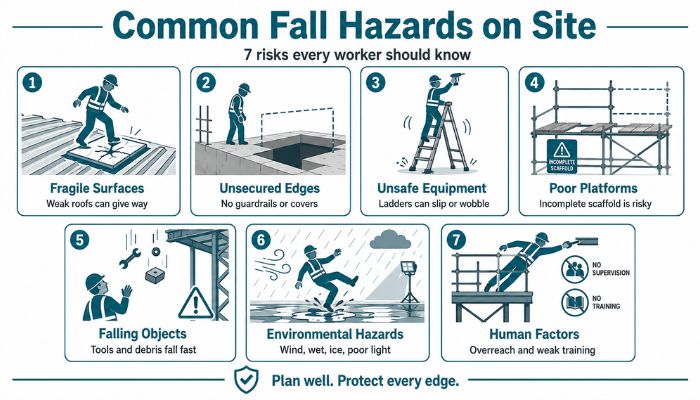
- Fragile surfaces: Walking on weak materials like fragile roofs or thin roof lights. These can give way instantly under a person’s weight.
- Unsecured edges: Working near open edges, floor holes, deep pits, or excavations without proper barriers or edge protection.
- Unsafe equipment: Using unstable ladders, poorly positioned stepladders, or damaged access tools that can wobble or slip.
- Substandard platforms: Standing on incomplete scaffolding or poorly maintained surfaces that lack proper boards or guardrails.
- Falling objects: Suffering an injury from loose materials, debris, or heavy tools dropped from above by other workers.
- Environmental hazards: Facing sudden risks like a strong gust of wind, poor lighting, or wet and icy surfaces that cause slips.
- Human factors: Overreaching to complete a task, working without direct supervision, or attempting a job with weak training.
How Do You Assess Working at Height Risks?
To do this, you should look at the following elements:
- The actual height of the specific task.
- How long the task will take to complete.
- How often workers must perform this duty.
- The physical condition of the working surface.
- The safety of the access route.
- Current and changing weather conditions.
- Nearby openings, voids, or unprotected edges.
- The presence of any fragile materials.
- The current condition of all safety equipment.
- The competence level of the chosen workers.
- Potential falling object risks to people below.
- Emergency rescue arrangements.
A good risk assessment should not only identify danger. It should decide exactly how to avoid, prevent, or reduce the risk before anyone leaves the ground.
How Can Employers Control Work at Height?
Here are the key steps for how employers control work at height, those are:
Plan the Work Safely
An effective work at height plan always starts with a strict safety check. Employers must assess the risks and look at control options in a specific order.
Avoid Work at Height First
First, you should always try to do the work from the ground where possible. For instance, you can use extendable tools to clean low windows or clear gutters. Alternatively, you can bring high machinery parts down to ground level for repair work.
Prevent Falls When Work Cannot Be Avoided
If you cannot avoid working at height, you must use equipment that prevents a fall from happening. This includes installing strong guardrails, erecting proper scaffolds, or using tower scaffolds.
Reduce Fall Distance and Injury
When you cannot eliminate the risk of a fall, you must reduce the distance and severity of the fall. You can place safety nets or soft landing systems beneath the work area. Furthermore, you can issue personal fall arrest equipment, such as harnesses connected to suitable anchor points.
Train and Protect Your Team
At the end, you must train workers thoroughly before they use any fall arrest equipment.
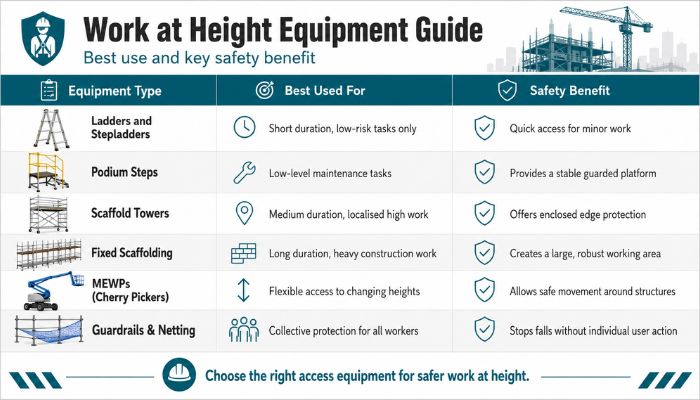
What Equipment Helps Ensure Safe Working at Height?
Choosing the right tool for the job forms a major part of safe working at height. Your choice should never depend on convenience alone.
What PPE Is Needed for Working at Height?
Personal protective equipment acts as your final line of defence against injury. You should use PPE alongside collective safety measures, not as a replacement for them. Essential items include:
- A safety helmet with a chin strap.
- Non-slip safety footwear.
- Protective gloves for grip.
- Eye protection against debris.
- High-visibility clothing for clear identification.
- A full-body safety harness.
- An energy-absorbing lanyard.
- A certified, tested anchor point.
PPE is not the first safety step you should take. Guardrails and platforms protect everyone in the area automatically.
What Is a Working at Height Rescue Plan?
A working at height rescue plan explains exactly how workers will get help fast after a fall or during an on-site emergency. You must write this plan before the work starts near any edge or drop.
The plan must match the specific site, the equipment in use, and the nature of the task. It needs to include who raises the alarm, who leads the rescue attempt, and what specialist rescue equipment is needed on site.
It must also detail how you will reach the suspended worker, how you will lower or move them safely, and who gives immediate first aid.
Finally, you must ensure that access routes stay completely clear for emergency vehicles. Fall arrest equipment may stop the fall successfully, but the rescue plan helps finish the emergency safely before suspension trauma sets in.
What Mistakes Should Workers Avoid?
Workers and supervisors should look out for these typical mistakes, which include:
- Starting a high-level task without a completed risk assessment.
- Using the wrong type of ladder for a heavy or long job.
- Overreaching to coat a surface or reach a component.
- Standing dangerously on the very top step of a stepladder.
- Ignoring strong wind or heavy rain during outdoor tasks.
- Working near fragile roof surfaces without protection boards.
- Carrying too many heavy tools while climbing a ladder.
- Using visibly damaged or uncertified access equipment.
- Blocking essential emergency access routes with materials.
- Skipping the creation of a detailed emergency rescue plan.
- Letting untrained or inexperienced workers do the job alone.
Final Thoughts on the Definition of Working at Height
What is the definition of working at height? It is any work where someone could fall and suffer injury if the right precautions are not in place. It is not about a fixed height, but rather about the chance of injury.
Employers must plan, assess, supervise and control the work diligently. Meanwhile, workers must follow their training and use all provided equipment properly.
Overall, working at height requires clear safety rules and proper preparation. It is not just about big tasks on tall scaffolding. It covers daily routines on step ladders, platforms, or near edges where a fall could cause harm.
For safety, always make sure workers have the right knowledge before they start. If you want to keep your team safe and avoid costly legal issues, proper training is a crucial first step.
Want to master safety rules and prevent fall risks on the job? Join our Working at Height Training course and learn step by step.
(Frequently Asked Questions (FAQs)
1. What does working height mean?
- The maximum level a worker safely reaches while standing.
2. What best defines working at height?
- Any work where a person could fall and suffer injury.
3. What is the 2m rule working at height?
- A scrapped rule; safety regulations now apply at any height.
4. What is the legislation for working at height in the UK?
- The Work at Height Regulations 2005 govern UK safety.
6. What are the 4 principles of HSE?
- Core values focus on prevention, protection, trust, and accountability.
7. Is scaffolding classed as working at height?
- Yes, scaffolding work carries a clear risk of falling.
8. What are 7 safety rules?
- Assess risks, wear PPE, train staff, maintain tools and stay alert.
9. What is the standard for work at height?
- Avoid heights, prevent falls, and reduce fall consequences always.

Working at Height Training
Course Description :
- Certificate: Yes(Free)
- Accreditation: CPD Accredited
- Access: Lifetime