
Knowing your subject is one skill. But helping someone else understand it is another. That is where AET starts to matter. But what is AET? AET stands for Award in Education and Training. It is a Level 3 qualification for people developing teaching and training skills. Interestingly, it is not only for complete beginners. Existing assessors can also use AET when moving towards a teaching role.
That makes AET a useful link between knowing a subject and teaching it well. It can help you turn your knowledge into clear lessons for other people. It also gives you a recognised starting point before you take on bigger teaching duties. So, it is important to understand what AET offers before choosing your next step.
But is it enough for the role you want? This guide breaks down what AET really offers, where its limits sit and what you should check before choosing it.
All the Key Facts You Need to Know About AET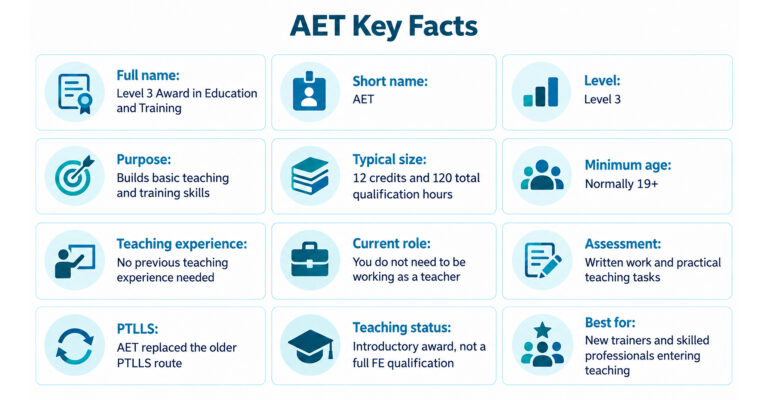
Here are the key facts that you need to know:
- Full name: Level 3 Award in Education and Training
- Short name: AET
- Level: Level 3
- Purpose: Builds basic teaching and training skills
- Typical size: 12 credits and 120 total qualification hours
- Minimum age: Normally 19+
- Teaching experience: No previous teaching experience needed
- Current role: You do not need to be working as a teacher
- Assessment: Written work and practical teaching tasks
- PTLLS: AET replaced the older PTLLS route
- Teaching status: Introductory award, not a full FE qualification
- Best for: New trainers and skilled professionals entering teaching
What Is AET and What Does the AET Qualification Mean?
The Level 3 Award in Education and Training (AET) is an introductory teaching and training qualification. It helps you build the basic skills needed to plan, deliver and support learning. AET can suit new trainers and skilled professionals moving into teaching. However, it is not a full FE teaching qualification. Recent changes to higher-level FE teacher training did not replace AET.
AET sits at Level 3, which describes the difficulty of the learning. However, this does not make it the same as an A-Level. Both can sit at Level 3 but their size and purpose differ. Basically, qualifications at the same level can require different amounts of study. They can also prepare learners for very different goals.
What Do You Learn on a Level 3 AET Course?
A Level 3 AET teaches the building blocks of good teaching. You learn how to plan and explain. A Level 3 AET course helps you build the core skills to plan, deliver and assess learning. You learn how to explain ideas clearly, support different learners and check their progress. The course also covers professional roles and boundaries. In practice, it helps you turn your subject knowledge into structured and effective teaching.
The main learning areas normally cover:
- Teaching duties: Understand your role and professional boundaries.
- Inclusive teaching: Support learners with different needs and starting points.
- Session planning: Set clear outcomes and organise useful activities.
- Teaching methods: Choose approaches that suit the topic and learners.
- Assessment and feedback: Check progress and help learners improve.
However, not every AET uses exactly the same unit combination. Approved routes can offer different optional units. Some focus more on inclusive teaching and assessment. Others can cover learning and development. The overall purpose stays similar but the evidence and practical tasks can differ between qualification routes.
But why does this matter? Two learners can take AET in slightly different ways and still gain a Level 3 award. One route may use microteaching, while another may need workplace practice. So, check the unit and assessment details before choosing an AET course.
How Is an AET Qualification Assessed?
An AET qualification is assessed through written work and practical teaching evidence. You normally need to show that you understand key teaching principles. You also need to show that you can use them in practice. Assessment can involve written tasks, session plans, observed teaching and a portfolio. The exact assessment method depends on the qualification route and chosen units.
Many AET routes use coursework instead of one final exam. You could explain teaching duties, plan a learning session and show how you assess progress. Your assessor then checks whether your work meets the required outcomes. Basically, AET assessment tests both knowledge and practical ability. It is not simply about remembering facts for a test.
What Is an AET Microteach?
An AET microteach is a short teaching session that shows your practical teaching skills. You plan the session, deliver it and receive feedback. The activity can check your timing, structure, explanation and learner engagement. It also gives you a chance to reflect on your teaching. Practically, it lets you demonstrate teaching skills without running a full class.
However, there is no single microteach length for every AET route. On some AET routes, learners complete at least one hour of microteaching. They also deliver an observed session lasting at least 15 minutes. Other routes can require teaching practice in a real workplace. So, the exact practical assessment can depend on the units you take.
Remote study still needs practical assessment. Some regulated AET routes allow online learning but they still need live observation. In these cases, a recorded microteach does not meet the rules. So, what should you do? Check the assessment method before you enrol, especially if the course is fully online.
How Long Does an AET Course Take?
There is no fixed calendar length for every AET course. A regulated Level 3 AET commonly has 120 total qualification hours. However, providers can spread those hours across different schedules. Some learners study over several days, while others take weeks or months. Your pace, assessment timetable and study format can all affect how long the course takes.
Guided learning hours cover supported study with a tutor or training centre. Total qualification time also covers private study, preparation and assessment. Course duration simply shows how a provider schedules that learning. So, a course advertised over three days does not mean the full qualification only takes three days to complete.
Can you complete AET online? Yes, some AET routes allow online or blended study. However, you still need to meet the practical assessment rules. Some routes need live teaching or microteaching observation. So, check how the provider manages this before you enrol. Flexible study can help but the course rules still come first.
What Qualifications Do You Need for AET Training?
You usually don’t need previous teaching experience to start a Level 3 AET course. You also do not need to be working as a teacher or trainer. AET is designed for people at an early stage of teaching. However, you need suitable English, maths and digital skills to complete the course and its assessments.
The main AET entry requirements are:
- Age: You normally need to be 19 or over.
- Teaching experience: Beginners can start AET.
- Current role: You do not need an existing teaching job.
- GCSEs: Specific GCSEs are not always required.
- Degree: You do not normally need a degree.
- Core skills: Providers can check your English, maths and digital skills.
Some AET qualifications have no fixed academic entry requirements. However, individual providers can set their own admission rules.
AET teaches you how to teach, not the subject itself. So, vocational trainers may still need the right qualifications or work experience. Basically, AET entry rules and teaching job rules are different. So, check both before choosing a course.
Is AET the Same as PTLLS? AET vs PTLLS Explained
No. AET and PTLLS are not the same qualification, although they serve a similar purpose. PTLLS stands for Preparing to Teach in the Lifelong Learning Sector. It was the older introductory teaching route. The Award in Education and Training (AET) later replaced it as the newer Level 3 route.
This is why people still connect AET with PTLLS. Both introduce the basic skills needed for teaching and training. However, they have different qualification titles and certificates. PTLLS is now a legacy qualification, while AET is the current route for new learners.
| Question | AET | PTLLS |
| Current route for new learners? | Yes | No, legacy route |
| Full name | Award in Education and Training | Preparing to Teach in the Lifelong Learning Sector |
| Main purpose | Introductory teaching and training | Similar introductory purpose |
| Same qualification? | No | No |
| Can it still be accepted? | Yes | Yes, in some settings |
Do You Need AET if You Already Have PTLLS?
Not always. An existing PTLLS qualification can still be accepted for some teaching and training roles. For example, current SIA trainer rules still recognise PTLLS alongside Level 3 AET and other accepted teaching qualifications.
So, do not assume you need to take AET again. Check the exact requirements for your role, employer or regulated sector. Your existing PTLLS can still meet the requirement in some settings.
Can You Teach With an AET Qualification?
Yes, an AET qualification can support some teaching and training roles. However, it does not qualify you to teach every subject or work in every setting. Your subject knowledge, employer and sector rules still matter. AET is commonly useful in workplace, adult, community, vocational and private training.
AET can support work in areas such as:
- Workplace and staff training
- Adult and community learning
- Vocational training
- Private training settings
- Specialist short courses where other rules are met
However, AET is not a universal legal licence to teach. In further education, some people can start teaching before gaining a full teaching qualification. Employers can support them while they train. Regulated sectors can also set extra trainer requirements. So, AET is useful but it is not compulsory for every adult teaching role.
The key difference is simple: AET teaches you how to teach, not the subject itself. For example, an experienced first aider can already have strong first aid knowledge. AET develops their planning, delivery, inclusion and assessment skills. Practically, professional trainers often need both teaching ability and strong subject competence.
Security training shows this clearly. AET can meet the teaching-qualification requirements for some SIA trainers. However, trainers also need relevant sector skills and experience. AET does not provide QTS, QTLS eligibility or specialist approval. Basically, it is a strong starting point rather than an all-purpose teaching qualification.
Is an AET a Full Teaching Qualification?
No. AET is not a full teaching qualification for further education. It is an introductory Level 3 award that builds basic teaching and training skills. In England, the Level 5 Diploma in Teaching (Further Education and Skills) is the main full FE teaching qualification. AET gives you the basics, while DiT prepares you for a wider teaching role.
AET also does not give you QTS or QTLS. QTS means Qualified Teacher Status and mainly relates to school teaching. QTLS is a professional status for eligible teachers in the FE and Skills sector. Completing AET alone does not give either status. Basically, AET is a starting qualification, not full professional teacher status.
Level 4 CET is above AET but below the Level 5 standard for full FE teacher training in England. It can help you build more teaching skills before higher study. However, AET and CET are not the same as a full Level 5 teaching qualification.
Does AET Reduce the Level 5 Diploma in Teaching?
Not automatically. In England, providers are not expected to use Level 3 AET or Level 4 CET to shorten Level 5 FE teacher training. These are separate qualifications with different levels and purposes.
AET can still prepare you for higher-level study. It builds useful skills in planning, assessment and teaching practice. However, it does not guarantee exemptions or a shorter Level 5 Diploma in Teaching (DiT).
Benefits of Completing an AET Qualification: Is AET Worth Doing?
Yes, AET can be worth doing if you already have knowledge you want to teach. It gives you a clear structure for planning, delivering and assessing learning. However, AET does not guarantee a job or higher pay. Its main value is helping you build practical teaching skills.
The main benefits of completing an AET qualification are:
- Better session planning: Set clear outcomes and organise learning well.
- Inclusive teaching: Support learners with different needs.
- Assessment skills: Check progress and give useful feedback.
- A simple starting point: Explore teaching before Level 5 study.
- Formal teaching knowledge: Add teaching skills to your subject experience.
AET is especially useful for people who already know their subject well. For example, an electrician, first aider or security professional can already have strong industry knowledge. AET helps them learn how to teach that knowledge clearly and confidently.
It can also help you decide whether teaching suits you. A Level 5 route needs more study and teaching practice. AET gives you a smaller starting point. Practically, it can help you build confidence before taking on a larger teaching qualification.
How Can You Check Whether an AET Qualification Is Properly Recognised?
For England and Northern Ireland, check the AET on the official Register of Regulated Qualifications. Match the qualification title, level, awarding organisation and qualification number with the course details. Wales and Scotland use separate qualification systems. Basically, use the correct regulator for where the qualification is regulated.
Then check what qualification you will actually receive. The course details should clearly explain its assessment and awarding organisation. A course called “AET” does not automatically mean it leads to a regulated Level 3 Award in Education and Training. So, check the qualification itself rather than relying on the course title.
Is a CPD certificate the same as a Level 3 AET? No. A general CPD certificate is not the same as a regulated AET qualification. Both can support learning but they serve different purposes. If your employer or sector asks for AET, make sure the certificate meets that exact requirement.
Studying AET online does not make it less recognised. What matters is the qualification and whether it meets all assessment rules. However, not every online AET course leads to a regulated qualification. So, check the award first, then check the assessment and observation rules.
Which Are the Best AET Course Providers in the UK?
Several UK providers offer the Level 3 Award in Education and Training (AET). The best choice depends on your study needs, budget and preferred level of support.
- Russbridge Academy (Best overall): Strong learner feedback with online, Zoom and classroom study options.
- Canary Wharf Academy (Best for budget and flexibility): Online, Zoom and classroom study options.
- School of Health Care (Best for fully online study): Offers a 100% online Level 3 AET with tutor support, flexible study and online assessment.
Before enrolling, check the awarding organisation, qualification number, assessment method and tutor support. Most importantly, make sure the course leads to the regulated Level 3 AET you need.
Final Thoughts: What Is AET and Is It Right for You?
So, what is AET in practical terms? It is a Level 3 introduction to teaching and training. It suits people who already know their subject and want to build teaching skills. AET can support workplace, adult, vocational and specialist training. However, it is not a full FE teaching qualification or a universal licence to teach.
Whether AET is right for you depends on your goal. Check what qualification your target role requires and what subject experience it needs. If AET meets those needs, it can be a strong starting point. If your role needs Level 5 training or another specialist qualification, choose that route instead.
FAQs
What Is AET for Universal Credit?
For Universal Credit, AET means Administrative Earnings Threshold. From 1 April 2026, it is £991 for one claimant and £1,597 for a couple in each assessment period. Basically, your earnings compared with this amount can affect your work-related requirements.
What Does AET Stand For?
In education, AET stands for Award in Education and Training. It usually refers to the Level 3 Award in Education and Training, an introductory teaching qualification. In Universal Credit, AET means something different: Administrative Earnings Threshold.
How Long Does an AET Qualification Take?
A Level 3 AET commonly has 120 total qualification hours but the calendar length varies. Some providers deliver the course over several days, while others spread learning and assessment over weeks or months.
What Does AET Stand For in Education?
In education, AET stands for Award in Education and Training. The Level 3 AET introduces core skills such as teaching, planning, assessment and supporting learners.
Is an AET a Full Teaching Qualification?
No. AET is an introductory Level 3 teaching qualification, not a full FE teaching qualification. In England, full FE teacher training usually sits at Level 5 or above.
How Much Is an AET Course?
There is no fixed price for an AET course in the UK. The cost depends on the provider, delivery method and what the fee covers, such as registration, assessment and certification.