
Have years of work experience and want to teach others? Your skills could open doors to a training career. That’s where Level 3 AET qualification jobs come in. They offer opportunities in workplace training, adult education and vocational teaching. With the Level 3 Award in Education and Training (AET), you can develop basic teaching skills. You could train staff, lead workshops or teach adults in your field.
For example, UK training officers earn £24,000–£40,000 a year, while FE teachers earn £28,000–£47,000. Online tutors can charge around £15–£40 an hour. However, these figures are not guaranteed AET earnings. Your career options depend on your experience, subject knowledge and extra qualifications.
So, what jobs can you get with AET? This guide explores career options, entry requirements, salaries and progression. You’ll also learn when AET is enough and when further qualifications are needed.
Level 3 AET Qualification Jobs: Which Roles Can You Apply For?
You can apply for a range of trainer and adult learning roles with Level 3 AET. However, each employer decides what skills and awards a job needs. AET teaches you about lesson plans, teaching methods and learner feedback. It does not replace hands-on skills in the subject you teach. Use this guide to spot roles that fit your background.
| Job Role | What You Could Do | What Else You Need | Estimated Annual Salary |
| Workplace Trainer | Train new and existing staff | Industry experience | £24,000–£40,000 |
| Vocational Trainer | Teach practical job skills | Trade skills and experience | £26,000–£45,000 |
| Adult Education Tutor | Teach courses for adults | Subject knowledge and provider requirements | £28,600–£34,400 |
| First Aid Trainer | Teach first aid courses | First aid skills and trainer requirements | £24,500–£40,000 |
| Care Trainer | Train health and care staff | Relevant care experience | £29,000–£35,700 |
| Security Instructor | Teach security courses | Security experience and extra training | £26,000–£35,400 |
| Corporate Trainer | Deliver staff skills training | Business or specialist knowledge | £29,300–£49,000 |
The job title alone rarely tells the whole story. A care trainer and a corporate trainer could both teach staff. Yet their daily work can look very different. Similarly, a vocational tutor might teach in a college or private centre. You could work full-time, part-time or on contract. Those terms describe how you work, not a new teaching qualification.
Which Industries Offer Training Roles for AET Holders?
AET can support training work in sectors where staff need clear, practical teaching. Your current trade or job often gives you a head start. But why? Hiring teams want trainers who know the work, not just the lesson plan. They also check for rules linked to each subject. These five areas offer useful career routes to explore.
- First aid and health and safety: Teach workplace first aid or safety skills. You also need sound first aid knowledge and the right proof of competence.
- Security: Explore door supervision, guarding or CCTV training. For several security roles, new trainers need two years of frontline work within five years. Extra awards also apply.
- Health and social care: Train care teams in safe working, staff induction or manual handling. Real care experience can help you explain daily tasks.
- Beauty, barbering and fitness: Teach practical lessons in a training centre. Providers can ask for trade awards, work experience and strong teaching skills.
- Construction and technical work: Explore trade tutoring, engineering skills or equipment training. Employers usually need clear proof that you know the tools and tasks.
Some less obvious roles involve airport operations, transport systems or specialist machines. These jobs depend on the employer and your own field. For instance, an airport trainer needs more than a teaching award. They need to understand the work and safety rules. Normally, a subject you know well gives you the best start. You can then build teaching skills around it.
Can You Teach Adults or Work in a College with Level 3 AET?

AET can help you teach short adult courses, workplace workshops and some community classes. It is a starting award, not a full FE teaching course. A local learning centre might recruit a tutor with strong subject skills. Still, the provider sets its own rules. The course type and teaching duties both matter.
College teaching can be more involved. Some colleges recruit skilled workers and support them while they gain higher teaching awards. Others ask for a full qualification when you apply. The Department for Education says AET does not cover the full skills of an FE teacher. So a college job is possible in some cases, but AET alone is not enough for every post.
School teaching has different rules. AET does not grant Qualified Teacher Status (QTS). In England, maintained schools normally need teachers with QTS, with some exceptions. Academies and independent schools can have different rules. Also, teaching assistant and learning mentor posts have their own entry terms. AET is not their usual main qualification.
Can You Become a Trainer with AET and No Teaching Experience?
Yes, you can find trainer routes without years of classroom teaching. But having no teaching experience differs from having no subject experience. A hiring team might value your years in care, building work or security. AET can then show that you have studied how to teach. Still, some jobs ask for past training work or further awards.
When looking at Level 3 AET job requirements, focus on what the role needs:
- Subject knowledge: Can you give correct answers and explain real tasks in plain English?
- Work history: Have you done the job you now want to teach others?
- Teaching skills: Can you plan a clear session and check that learners understand?
- Extra checks: Does the job need safety awards, safeguarding checks or official approval?
Picture two applicants. One has five years in a care home and has just gained AET. The other holds AET but has never worked in care. Both understand basic teaching methods. However, the experienced worker can also explain daily care tasks. That difference can matter in a care trainer interview. Some employers even support skilled recruits while they train for a teaching award.
What Assessment Work Can You Do with Level 3 AET?
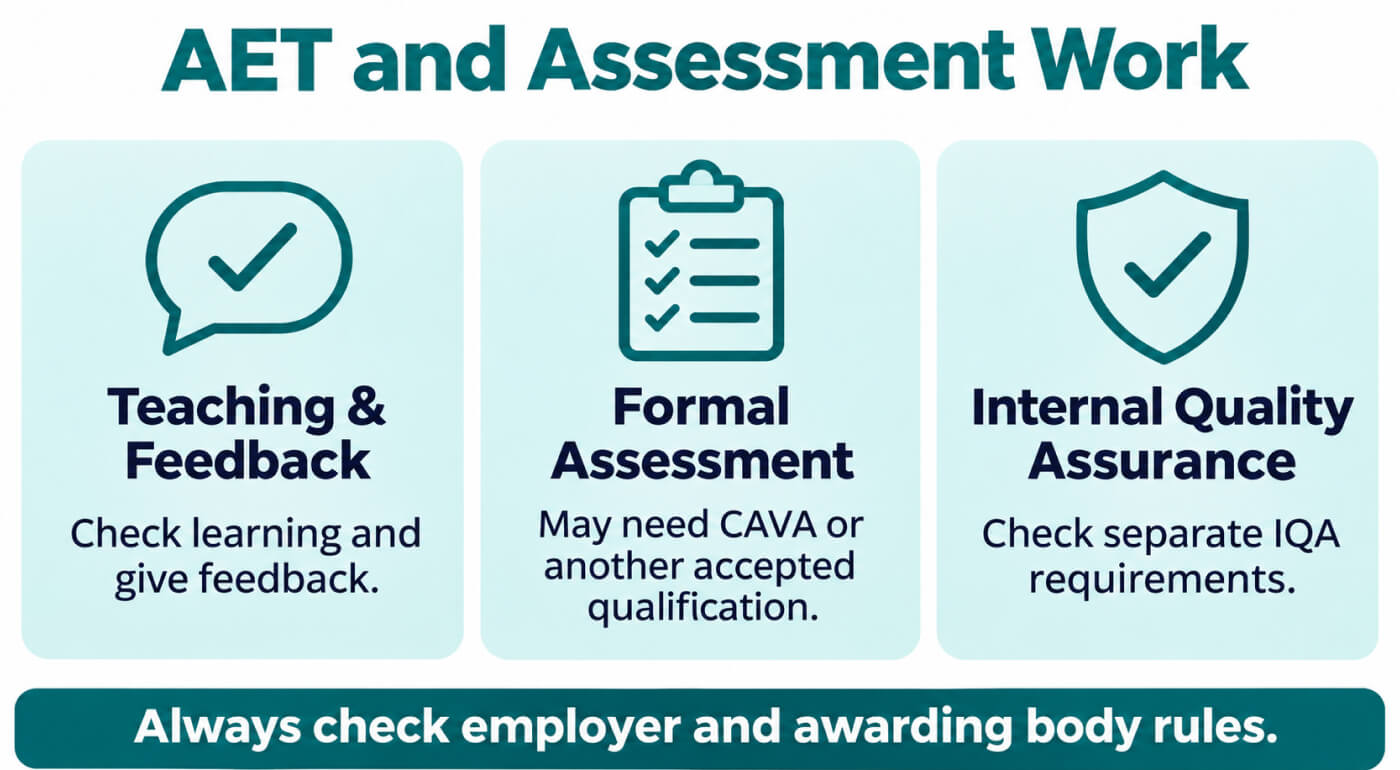
AET shows you how to check learning and give feedback. Yet judging a regulated award can involve extra rules. You need to know who sets those rules before taking an assessor job. Some employers want a separate assessor award, such as the Level 3 Certificate in Assessing Vocational Achievement (CAVA). Others accept a suitable teaching award for defined tasks.
- Teaching and feedback: You plan lessons, ask questions and check what learners understand.
- Formal assessment: You judge work against set standards, where the course rules permit that work.
- Internal quality assurance: You check whether assessors make fair and steady decisions. This role has its own skills and requirements.
Here is a detail worth knowing. The SIA accepts Level 3 AET for certain assessor roles under its rules. HSE guidance also lists AET for both training and assessment in workplace first aid. Still, both areas have other conditions. So CAVA is useful for some careers, but it is not a rule for every assessment task. You can check the SIA’s official trainer and assessor requirements for more details.
Where Can You Find Jobs That Accept an AET Qualification?
Search for the work you want to do, not just the name of your award. Employers often use job titles such as trainer, tutor or learning officer. Some adverts name AET, while others ask for an equal teaching award. You can check the government’s Find a Job service and local colleges’ own job pages. Then read each advert in full.
These search terms can uncover different career paths linked to AET:
- AET or PTLLS trainer: Find jobs that name these introductory teaching awards.
- Vocational tutor: Look for teaching roles linked to your trade or work skills.
- Workplace training officer: Explore staff induction and in-house learning roles.
- Adult learning tutor: Search for community classes and short adult courses.
- Associate trainer: Look for paid sessions, contract work and specialist training days.
A small change in search words can make a big difference. For example, ‘Level 3 jobs’ often means jobs needing a Level 3 trade award. It does not always mean the AET award. Try adding your subject, such as ‘care trainer AET’. Then open the essential criteria. That helps you avoid jobs that do not match your skills.
How Can You Tell Whether an AET Job Advert Is Right for You?
A good job advert should fit your skills, not just your award. So read the duties and the key rules as two separate parts. One trainer vacancy could focus on teaching staff. Another could involve marking course work, keeping records and checking quality. The same job title does not always mean the same work. Five quick checks can save a poor application.
- Essential or preferred: Does the employer demand AET, or simply see it as a bonus?
- Teaching or assessing: Will you teach sessions, mark work or do both?
- Work experience: Does the job ask for recent work or proof of past training?
- Paid time: Will the employer pay for planning, travel and written records?
- Extra approval: Are safety checks, specialist awards or course approval part of the role?
Imagine a fictional vacancy asking for What Is AET Level 3 and three years of trade experience. A new AET holder with those trade skills could meet both points. Someone without the trade background would not. The small print matters here. Check the closing date and work location too. Then judge the full role, not only the teaching award in its title.
How Much Do Level 3 AET Qualification Jobs Pay in the UK?
Jobs that accept Level 3 AET do not have one fixed salary in the UK. Pay depends on the role, industry, working hours and location. The National Careers Service lists £24,000 a year for starting training officers and £40,000 for experienced staff. However, these figures cover the training officer role generally. They are not guaranteed salaries for people with AET.
Further education teachers have a different pay range. The National Careers Service lists £28,000 a year for starters and £47,000 for experienced teachers. However, these figures cover FE teaching careers, not just entry-level AET jobs. Some teaching posts also require higher qualifications. So, keep this difference in mind when comparing job adverts and expected earnings.
Part-time tutors can earn hourly pay or receive payment for each teaching session. Similarly, freelance trainers can charge daily rates or agree on a fee per course. However, higher fees do not always mean higher take-home earnings. Travel, lesson planning, insurance and quiet weeks can reduce income. Before accepting a job, check whether the employer also pays for lesson preparation and reports.
Can You Work Freelance or Teach Online with an AET Qualification?
Yes, AET can support freelance or online training when you have suitable subject skills. A freelance trainer might teach for several providers or run workshops for local employers. Online tutors can deliver lessons through video calls or learning sites. But the award alone does not give approval to run every regulated course. The course rules still apply, wherever learners sit.
There is a real difference between a skills workshop and a regulated qualification. You could teach an informal session on a topic you know well. Yet offering approved certificates often needs an agreement with an awarding body. Security training is one example. The SIA requires suitable centre approval and sets rules for virtual classes.
Practical training also has limits online. First aid and physical skills often need face-to-face checks. Some course work can still run online. As a freelancer, you also need to plan for insurance, course materials and finding clients. Keeping records can take time after a class ends. Ask yourself whether you want to teach more, or run a business as well.
Which Qualifications Can Help You Progress After Level 3 AET?
After Level 3 AET, you can progress through Level 4 CET, Level 5 teacher training or specialist qualifications. However, the right choice depends on the job you want. Teaching in further education differs from assessing work-based skills. Similarly, checking assessment quality requires different skills. So, before choosing another course, check what your preferred job requires. This can save you time and unnecessary costs.
When Is a Level 4 Certificate in Education and Training Useful?
The Level 4 Certificate in Education and Training (CET) helps you develop your teaching skills beyond AET. It can suit people who already teach and want more practice. However, CET is not a full further education (FE) teaching qualification. If you want to teach in a college, check which qualifications employers require. AET and CET support different stages of teaching development.
When Should You Consider a Level 5 Diploma in Teaching?
The Level 5 Diploma in Teaching (Further Education and Skills) supports full FE teacher training. In England, new rules apply to specified FE teacher training courses starting from September 2026. These rules do not directly apply to Level 3 AET or Level 4 CET. The Department for Education also does not expect providers to count these awards as prior-learning credit towards Level 5 or higher qualifications. You can check the official FE teacher training guidance for more details.
When Is a Specialist Qualification More Useful?
A specialist qualification can be more useful if you want to assess learners or check assessment quality. For example, CAVA can support a move into assessing work-based skills. Similarly, an internal quality assurance award can support work checking assessment decisions. Security, first aid and other trades also have their own instructor requirements. So, choose a qualification that matches your career goal rather than simply studying at a higher level.
Final Thoughts: Which Training Career Fits Your Experience?
The best Level 3 AET qualification jobs often build on skills you already use at work. A care worker could explore staff training. A tradesperson could look at vocational teaching. Someone with business skills could train teams. Still, job rules vary, so check each vacancy before applying. Your subject knowledge matters just as much as knowing how to teach.
So what should you do now? Choose one field and read several job adverts. Note the teaching award, work history and extra training they require. Then decide whether AET fits your plan. If you have not studied it yet, check the course award. See how the course tests your skills before you enrol.
What if the skills you’ve spent years learning could become the lessons you teach others? Turn your experience into new career opportunities with our Level 3 AET Course at School of Healthcare.
FAQs About Level 3 AET Qualification Jobs
1. What Can I Do with AET Level 3?
With Level 3 AET, you can explore jobs in workplace training, adult education and vocational teaching. You could become a workplace trainer, adult education tutor or specialist instructor. However, your job options depend on your subject knowledge, experience and any extra qualifications employers require.
2. What Is AET Level 3 Equivalent To?
Level 3 AET sits at the same qualification level as A levels in England. However, it covers different skills and involves less study than a full A level programme. It is an introductory teaching award, not a degree or full teaching qualification.
3. Will a Level 3 AET Course Qualify Me?
Completing a recognised Level 3 AET qualification gives you an introductory teaching award. It can support applications for certain training and adult education roles. However, it does not automatically qualify you for every teaching job or grant Qualified Teacher Status (QTS).
4. How Long Does AET Level 3 Take?
A Level 3 AET course can take around 5 days on an intensive programme. Part-time courses often run for 10 to 16 weeks. However, the exact duration depends on the provider, study method and time needed to complete your assessments.
5. How Much Does a Level 3 AET Course Cost?
Level 3 AET course fees vary between UK training providers. Current college examples range from around £345 to £550, although some providers charge more. Your final cost depends on the provider, learning method and any extra fees. Always check the full price before enrolling.
6. How Hard Is a Level 3 Qualification?
Level 3 AET is an introductory teaching qualification, but it still requires study and practical work. You need to understand teaching methods, complete assignments and deliver a short practice lesson. The difficulty depends on your experience, confidence and study skills. Regular preparation can make the course easier to manage.