
Would you like to know is ptlls a teaching qualification that employers still accept? Yes, PTLLS was an introductory course for teaching adults. These days, the Level 3 Award in Education and Training (AET) has taken over as the main starting route.
So, do employers still accept it? Fortunately, many employers still accept older PTLLS certificates for entry-level teaching roles. Meanwhile, new learners must take the updated AET course. Additionally, higher jobs may need a Level 4 or Level 5 diploma.
Now, let us explore what you can teach, replacement courses, and how to start your career.
Is PTLLS a Teaching Qualification?
Well, PTLLS stands for Preparing to Teach in the Lifelong Learning Sector. It was a special beginner course for adults who wanted to teach or train others outside of normal schools. So, who was this course for? It was made for adults, like a skilled hairdresser who wanted to teach hair design or an office worker training new staff. This learning took place in colleges, adult classes, and workplace training centres.
The course helped new teachers learn the basics of teaching in four simple steps. They learned how to plan a lesson with clear goals. Then, picked fun activities to help students understand the topic. After that, they helped learners with different needs so everyone could join in. Finally, they checked how well students were doing by asking questions and giving helpful feedback. However, having this certificate only proved you knew how to teach, not that you were an expert in the subject itself.
Because PTLLS came in different levels, like Level 3 and Level 4, you should always check the level printed on your certificate. Today, people do not take PTLLS anymore because it is an older course. So, what course do new teachers take now? Today, adults who want to start teaching usually take a course called the AET instead.
Is PTLLS Still a Recognised Qualification?
Yes, a PTLLS certificate can still be useful today. However, whether an employer accepts it depends on the job you want. Is your old certificate still valid? Yes! Ending the course does not mean your certificate stops working. If you finished a real course, you can show it to employers to prove you trained as a teacher.
Does every PTLLS certificate teach the same things? No, they can be quite different. Some are Level 3, while others are Level 4. Because of this, employers look at the level and who gave you the certificate. So, what should you do if you have a PTLLS certificate? First, read the full name and level on your paper. Next, write down the date and the name of the organisation that issued it. After that, check if these details match what the job needs.
What if you lost your paper? In that case, you should contact the awarding organisation for help. In the end, you must ask the employer if they accept PTLLS. This is because one employer might say yes, but another might ask for a newer qualification like AET instead.
What Replaced PTLLS in the UK?
The Level 3 Award in Education and Training (AET) is the main new course that replaced PTLLS. It gives new teachers and trainers a great starting point to learn about teaching.
In this course, learners find out how to plan fun lessons, choose good activities, help their students, and check their progress. Because of this, it is very helpful for anyone who wants to teach adults or train people at work.
AET is a great first step if you want to become a teacher. However, finishing this course does not automatically mean you can do every teaching job. What do you need to check before you start? Since different course providers have different rules and test methods, you should always check the course details before you sign up.
Official UK education records show that AET is a Level 3 course. For instance, one record says it takes 48 hours of guided learning and 120 hours of total study time. Therefore, these numbers just show how much study time is expected, rather than a fixed number of days you must sit in a classroom.
At the end, if you are a new learner, you should look for an approved AET course instead of searching for PTLLS. Before you pay any money, make sure to double-check the course details, the test methods, and the full price.
Where Can You Study the Level 3 AET Course?
Are you excited to turn your practical skills and experience into a real teaching qualification? Where can you actually take this course? The good news is that several trusted training providers across the UK are ready to help you get started:
- Russbridge Academy (Best overall option): Which provider offers the most flexible learning formats? Russbridge Academy is highly rated by learners and provides flexible study choices through online modules, live Zoom sessions or traditional classroom settings.
- Learn More Academy (Best for varied learning options): How can you study if you prefer interactive or regional learning? Learn More Academy provides flexible study routes through live Zoom sessions as well as nationwide classroom locations across the UK.
- Canary Wharf Academy (Best for budget and flexibility): What if you are looking for an affordable yet flexible route? Canary Wharf Academy offers accessible study options across fully online, virtual Zoom, and face-to-face classroom environments.
- School of Health Care (Best for fully online study): Can you complete your entire qualification from home? The School of Health Care provides a 100% online Level 3 AET with dedicated tutor support, flexible self-paced learning, and smooth online assessments.
What Are the Entry Requirements for PTLLS Or AET?
PTLLS is an older name for this course, so you should look for AET courses. The great news is that you do not need any teaching experience to join! Can anyone take this training? Yes, as long as you can read, write, and speak clear English so you can do your work and talk to others.
Before you sign up, check what tasks you will need to do. What is microteaching? It is a short practice lesson where you teach a small group to show your skills and get feedback. Some courses ask for this, while others might ask for written work or a quick presentation instead.
Think about what you want to do after the course. Will this course help you get your dream job? It is best to check job adverts first so you can pick the right training for your future. This way, you do not waste your money on a course that an employer does not want!
How Much Do PTLLS or AET Cost?
The PTLLS course is no longer available for new students. If you want to train, you need to take the AET course instead.
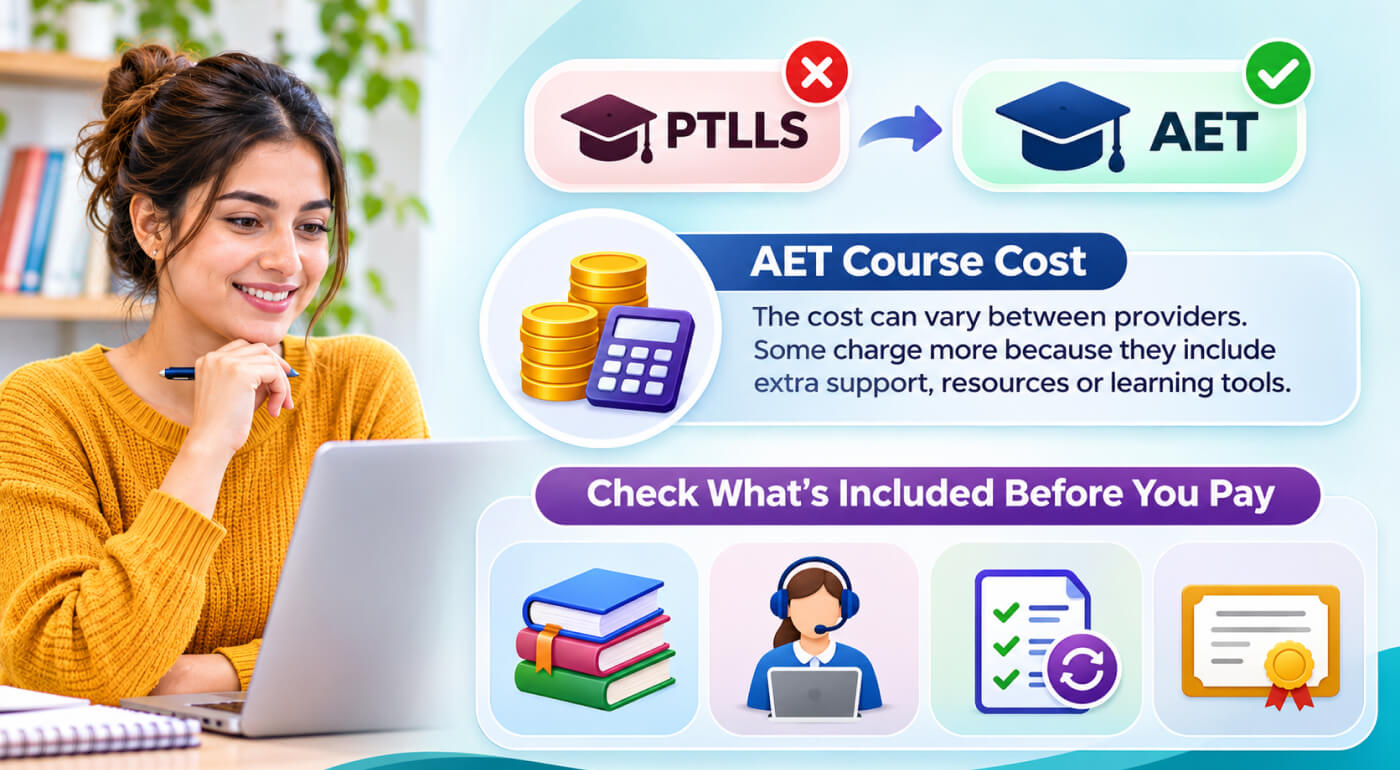
The cost of an AET course changes depending on where you look. Some schools charge more because they give you extra teacher support, books, or online learning tools. Are all course fees the same? No, so you should always check what is included in the price. Before you pay, make sure the full cost covers:
- Your books and study guides.
- Help from a tutor and marking your work.
- Extra fees if you need to try an assignment again.
- Your final qualification certificate.
A course might look cheap at first, but hidden costs can make it more expensive later. Therefore, always ask the training centre for a full price list before you sign up.
Do you already have a PTLLS certificate? If so, talk to your boss before paying for the AET. Your employer might accept your old PTLLS qualification, so you will not need to spend money doing the training again.
How Can You Progress After PTLLS or AET?
So, you have finished your introductory teaching course (PTLLS or AET). What should you do next? The answer depends on your goals, your subject, and your experience. Here is a simple step-by-step path you can follow.
Step 1: Decide How Far You Want to Train
- Option A: You can take the Level 4 Certificate in Education and Training if you want to skill up step by step.
- Option B: Alternatively, you can aim directly for a full Level 5 qualification, such as the Level 5 Diploma in Teaching and more.
What are you going to learn in a Level 5 Diploma? It helps you grow as a teacher by showing you how to plan lessons, teach your subject, assess students, and improve your classroom skills. Most importantly, it includes real teaching practice so you can learn on the job!
Step 2: Explore University Routes
Look into university-linked courses. Depending on your past studies and future plans. For instance, a Certificate in Education (Cert Ed) or a higher-level degree might be the best match for you.
Step 3: Check Your Trade Skills and Work Experience
If you want to teach a practical trade (like plumbing or hairdressing), is a teaching qualification enough? No, it usually isn’t! You will also need:
- A recognised trade qualification in your field.
- Recent hands-on experience so you can teach your students safely and correctly.
Step 4: Get an Assessor Qualification (If Needed)
After that, check if your target job involves testing students at work. Will you be checking people’s skills in a real workplace? If so, you will need a separate Assessor Qualification alongside your teaching certificate.
Step 5: Check Entry Rules Before You Apply
Last but not least, before you pick any course, always check its entry requirements and match them with the jobs you want. This final check ensures you pick the perfect path to reach your dream teaching job!
Conclusion On Is PTLLS a Teaching Qualification
A clear understanding of PTLLS and current teaching qualifications helps you make the right choice for your career in education. Although PTLLS is an older award, it still holds value for many employers, while the Level 3 Award in Education and Training (AET) offers the main starting route for new learners today.
So, do you need a new qualification if you already hold a PTLLS certificate? In short, not always because many employers still accept PTLLS for entry-level teaching and training roles! However, if you want to teach in formal settings or progress into higher roles, you may need to upgrade to a Level 4 or Level 5 course.
If you are ready to take your next step, explore the training options at School of Health Care to find the right path for your teaching goals.
FAQs About Is PTLLS a Teaching Qualification
1. Can I teach with a PTLLS qualification?
Yes. A PTLLS qualification allows you to teach in the Further Education (FE) and post-16 adult learning sectors, enabling you to deliver short or non-accredited courses.
2. Are PTLLS qualifications still valid?
Yes. Although PTLLS was replaced by the Level 3 Award in Education and Training (AET), existing PTLLS qualifications remain valid and fully recognised by employers.
3. What are the equivalent qualifications for PTLLS?
The Level 3 Award in Education and Training (AET) is the direct modern equivalent to PTLLS. Higher equivalents include the Level 4 CET (CTLLS) and Level 5 DET (DTLLS).
4. Does a PGCE qualify you to teach?
Yes. Completing a PGCE grants academic teaching credits and usually leads to Qualified Teacher Status (QTS) in schools or Qualified Teacher Learning and Skills (QTLS) in further education.
5. Can a TA become a teacher without a degree?
No. You cannot gain full Qualified Teacher Status (QTS) without a bachelor’s degree. However, Teaching Assistants (TAs) can earn a degree through work-based degree apprenticeships while working.
6. What does PTLLS stand for?
PTLLS stands for Preparing to Teach in the Lifelong Learning Sector. It was an introductory UK teaching qualification for adult and further education.
7. What does a TA earn per hour?
Teaching Assistants typically earn £12.50 to £16.50 per hour in the UK, depending on their location, experience level, and higher-level teaching assistant (HLTA) status.
8. What’s the hardest age to teach?
Middle school and early adolescence (ages 11 to 14) are widely considered the hardest to teach due to rapid brain development, shifting peer dynamics, and emotional transitions during puberty.