
Want to know how to become a transport manager in the UK? Start by choosing between road haulage and passenger transport. Then, pass both Transport Manager Certificate of Professional Competence (CPC) exams and find a suitable transport operator. The relevant regulator must approve your appointment before you can manage its licensed operations.
You don’t need a degree, driving licence or previous experience to sit the CPC exams. However, approval also depends on your good repute, current knowledge and ability to manage a fleet. Once appointed, you’ll oversee vehicle safety, driver compliance and transport records.
Now, let’s explore the qualification steps, training costs and legal requirements to help you start this career.
What Does a Transport Manager Do in the UK?
A transport manager makes sure a company’s goods or passenger vehicles operate safely, legally and efficiently. They oversee drivers, vehicle maintenance, transport schedules and daily compliance checks. Unlike a transport planner, they also monitor whether the business meets its operator licence conditions. Their responsibility goes beyond organising journeys. They must spot risks, correct problems and keep transport operations under control.
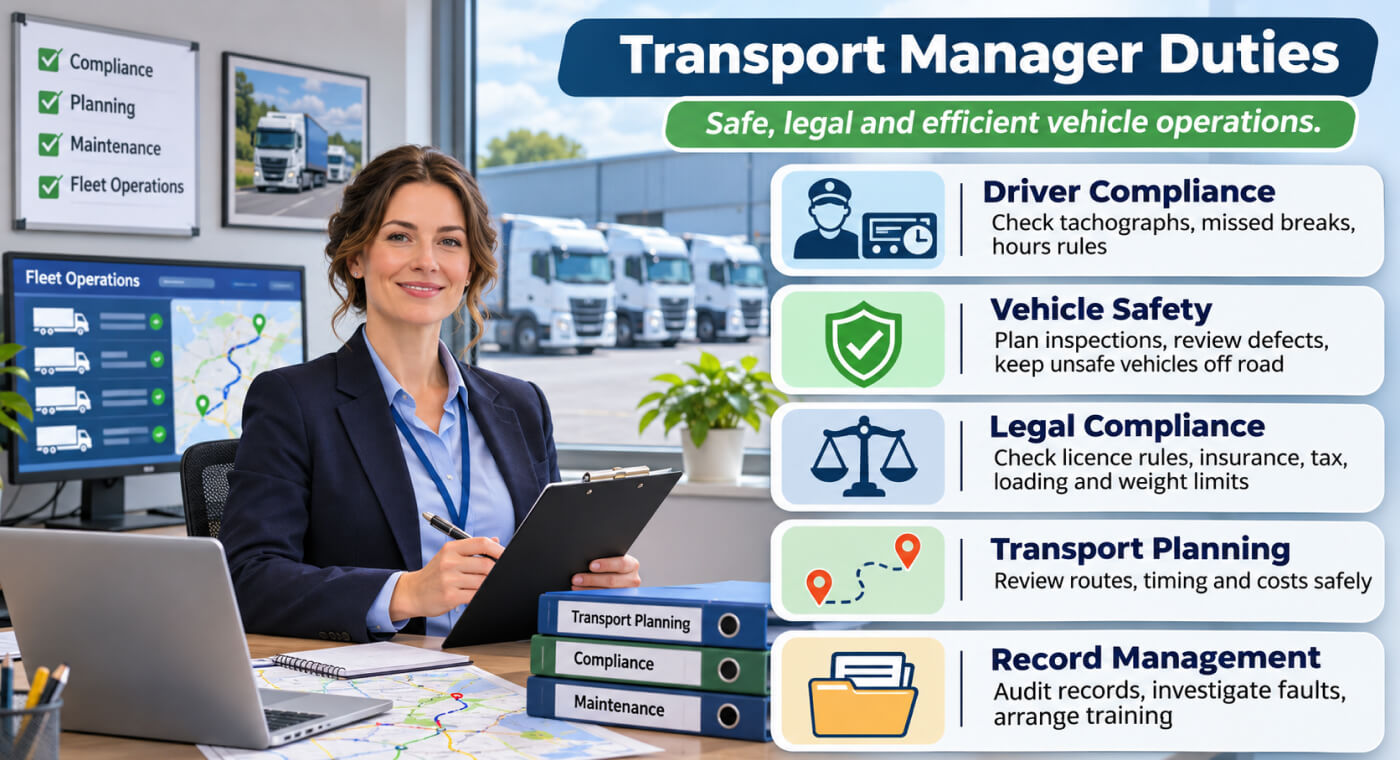
The main duties of a transport manager are:
- Driver Compliance: Review tachograph data, identify missed breaks and address repeated drivers’ hours breaches.
- Vehicle Safety: Schedule inspections, review defect reports and keep unsafe vehicles off the road until repaired.
- Legal Compliance: Check operator licence conditions, vehicle insurance, tax, safe loading and weight limits.
- Transport Planning: Review routes, delivery times and operating costs without putting drivers under unsafe pressure.
- Record Management: Audit maintenance records, investigate recurring faults and arrange staff training where needed.
But what happens when a driver reports a serious brake fault before a delivery? The transport manager must make sure the vehicle stays off the road until it is safe. They must also confirm the repair and keep accurate records.
This shows what makes the role different. A transport manager doesn’t just organise daily work. They check whether safety systems actually work and take action when problems arise.
How to Become a Transport Manager Step by Step?
To become a transport manager in the UK, you must gain the right CPC qualification and regulatory approval. The process involves choosing your transport sector, passing two exams and securing a suitable role. Here’s how to complete each stage and avoid common mistakes.
- Step 1 – Check Your Eligibility: You don’t need a degree, driving licence or previous experience to sit the CPC exams. However, becoming a nominated manager also requires good repute and meeting the relevant legal requirements.
- Step 2 – Choose the Right CPC Qualification: Select Road Haulage CPC to manage goods vehicles or Passenger Transport CPC for buses and coaches. You’ll need both qualifications if you plan to manage both sectors.
- Step 3 – Prepare for Your CPC Exams: Choose classroom training, online learning or independent study. Paid training isn’t compulsory. However, check the approved awarding body, exam dates and fees before booking.
- Step 4 – Pass Both CPC Exams: Complete the multiple-choice and case study assessments. Both papers test your knowledge of transport laws, business operations and safety requirements. You must pass both to earn your qualification.
- Step 5 – Find a Suitable Transport Operator: Apply for an employed position, explore external management contracts or manage your own transport business. Make sure you have enough time and authority to handle the role.
- Step 6 – Secure Regulatory Approval: Your transport operator must apply to name you on its operator’s licence. In Great Britain, a Traffic Commissioner must approve your appointment before you begin the nominated role.
Keep in mind: Your CPC confirms your professional knowledge but managing a fleet requires practical judgement. Building experience in transport planning, vehicle safety and driver compliance can help you prepare for the responsibility.
What Qualifications Do You Need to Become a Transport Manager?
To become a transport manager in the UK, most new applicants need a Transport Manager Certificate of Professional Competence (CPC). This qualification shows that you understand transport laws, fleet safety, business operations and legal responsibilities. It is the main qualification for managing transport operations under a standard operator’s licence. However, some older qualifications and recognised acquired rights may also count.
The Transport Manager CPC is different from the Driver CPC, which covers professional driving requirements. You don’t need a university degree to gain this qualification. However, earning your certificate is only part of becoming a nominated transport manager. You must also meet the relevant legal requirements before taking responsibility for a licensed fleet.
Can You Become a Transport Manager Without Experience or a Driving Licence?
Yes, you can take the Transport Manager CPC exams without any past transport experience or a driving licence. There is also no minimum age to take these exams. So, this is a good option if you want to start a new career. However, employers may prefer people who understand daily transport work and know how to deal with problems.
Experience in transport planning, logistics or depot operations can help you build these skills. You must also demonstrate good repute and the ability to manage transport activities effectively. For goods transport managers in Great Britain, living in the UK is another requirement. So, while previous experience isn’t essential for taking the exams, practical knowledge can help you succeed in the role.
Which Transport Manager CPC Qualification Should You Choose?
Choosing the right Transport Manager CPC qualification depends on the type of vehicles you want to manage. The UK offers two main routes:
- Road Haulage CPC and
- Passenger Transport CPC
Both cover transport management but they focus on different operations and legal requirements. Comparing both options makes it easier to find the right qualification for your career.
| Feature | Road Haulage CPC | Passenger Transport CPC |
| Main purpose | Managing goods transport | Managing passenger transport |
| Typical vehicles | Lorries and relevant vans | Buses and coaches |
| Common employers | Haulage, logistics and delivery companies | Bus, coach and tour operators |
| Key areas | Freight operations, safe loading and goods transport rules | Passenger services, scheduling and passenger transport rules |
| Career path | Road haulage transport manager | Passenger transport manager |
If you want to manage delivery vehicles, freight services or logistics fleets, Road Haulage CPC is the suitable choice. However, Passenger Transport CPC is more relevant for managing bus and coach operations. If your career involves both sectors, you’ll need both qualifications because one does not replace the other.
You should also check what your older CPC qualification allows you to do. For example, some older national-only certificates are still valid for road haulage work within the UK but not for international work. So, checking your certificate before joining a course can help you avoid paying for training you may not need.
How Do Transport Manager CPC Training and Exams Work?
The Transport Manager CPC tests how you would run a safe and lawful fleet. You can study at home, online or in a classroom. A tutor can help with hard case studies. But you do not have to pay for a course before the exams.
What Does the Transport Manager CPC Exam Include?
You must pass a multiple-choice paper and a case study. They test knowledge and judgement. Four subjects deserve close attention:
- Transport law: Operator licences, contracts, drivers’ hours and rest breaks.
- Business finance: Budgets, running costs and simple calculations.
- Vehicle compliance: Inspections, repairs, road safety and maintenance.
- Daily operations: Routes, driver schedules and decisions when plans change.
Imagine a delivery running late while a driver nears their legal driving limit. What should you do? The case study tests that kind of judgement. Ask your exam body about timings, pass marks and resit rules. GOV.UK lists six approved awarding bodies. They are CILT, City & Guilds, Innovate Awarding, NLTC, NOCN Group and SEG Awards.
How Much Does Transport Manager CPC Training Cost?
Transport Manager CPC training costs vary depending on the provider and study method. For example, CILT’s published prices list £1,125 for non-member self-study and £1,800 for blended online learning. Its classroom-based course costs £1,980. These are CILT’s listed prices, not UK-wide averages. Before enrolling, check whether the price includes exam fees, learning materials, tutor support and resits.
The time needed to complete Transport Manager CPC training also depends on your chosen course. Some intensive courses take around two weeks. CILT offers three weeks of classroom training and six to eight weeks of blended learning. Self-study learners can access its materials for up to two years. However, your actual completion time depends on exam dates, results and possible resits. You should also allow extra time for regulatory approval before starting a nominated transport manager role.
How Do You Get Approved on an Operator’s Licence?
The firm must apply to name you as its transport manager. In Great Britain, a Traffic Commissioner must agree before you take on that role. Passing the CPC does not mean you get the go-ahead. Normally, the checks cover four things about you and the job.
- Professional competence: Do you hold the right CPC or another valid award?
- Good repute: Do past offences or transport penalties raise concerns?
- Working time: Can you give the fleet enough time each week?
- Current knowledge: Do you know the current rules?
According to GOV.UK, the approval checks usually take around seven weeks. However, they may take longer in some cases. You must also have enough time each week to manage the vehicles properly. For example, the guidance suggests four to eight hours a week for three to five vehicles. However, trailers, other jobs and a busy fleet may mean you need more time. The regulator checks the work you actually do, not just the hours you put on the form. So, if you plan to work fewer hours, you must explain how you will still keep the fleet safe.
What if you earned your CPC many years ago? You should keep your knowledge up to date through regular study. The Traffic Commissioner may ask for proof if your CPC is over ten years old. They may also ask if you haven’t worked as a named transport manager for five years.
In Northern Ireland, the Transport Regulation Unit handles approval instead. If the regulator does not approve you, you may need more training. In serious cases, you could face a ban from working as a transport manager. For more details, see the official appointment rules.
Should You Work as an Internal or External Transport Manager?
An internal transport manager has a real work link with the firm. That could mean being an employee, director or working partner. An external transport manager works under a direct contract. Both must do the job, not just put their name on a licence. Your best option depends on your skills and free time.
Working as an internal transport manager keeps you closer to the drivers and the depot. This helps you spot problems early and make sure repairs get done. On the other hand, external work gives you more freedom. However, you must manage your time carefully for each client. In both roles, the company must let you make important safety decisions. What matters most is not your job title but how much control you have over transport operations.
How Many Operators Can an External Transport Manager Work For?
The usual legal limit is four operators and 50 vehicles in total. But the Traffic Commissioner can set a lower limit. Think of two small fleets based far apart. Even with few lorries, travel could leave too little time for good checks. So, time and distance matter just as much as fleet size.
Your contract should state your duties, work hours and access to records. For external work, the contract must name you as a person. A consultancy cannot simply rent out your CPC. Internal managers can sometimes cover more than one fleet too. The regulator checks every role you hold, inside and outside the firm. A mix of these jobs can affect the number of fleets you are fit to manage.
How Can You Get Your First Transport Manager Job in the UK?
Your Transport Manager CPC shows your knowledge, but employers also want good judgement. You can start as a transport clerk, planner, depot supervisor, HGV driver or assistant transport manager. These jobs help you understand drivers, vehicles and daily problems. An apprenticeship or degree can also help, but neither replaces the CPC requirement for a named manager.
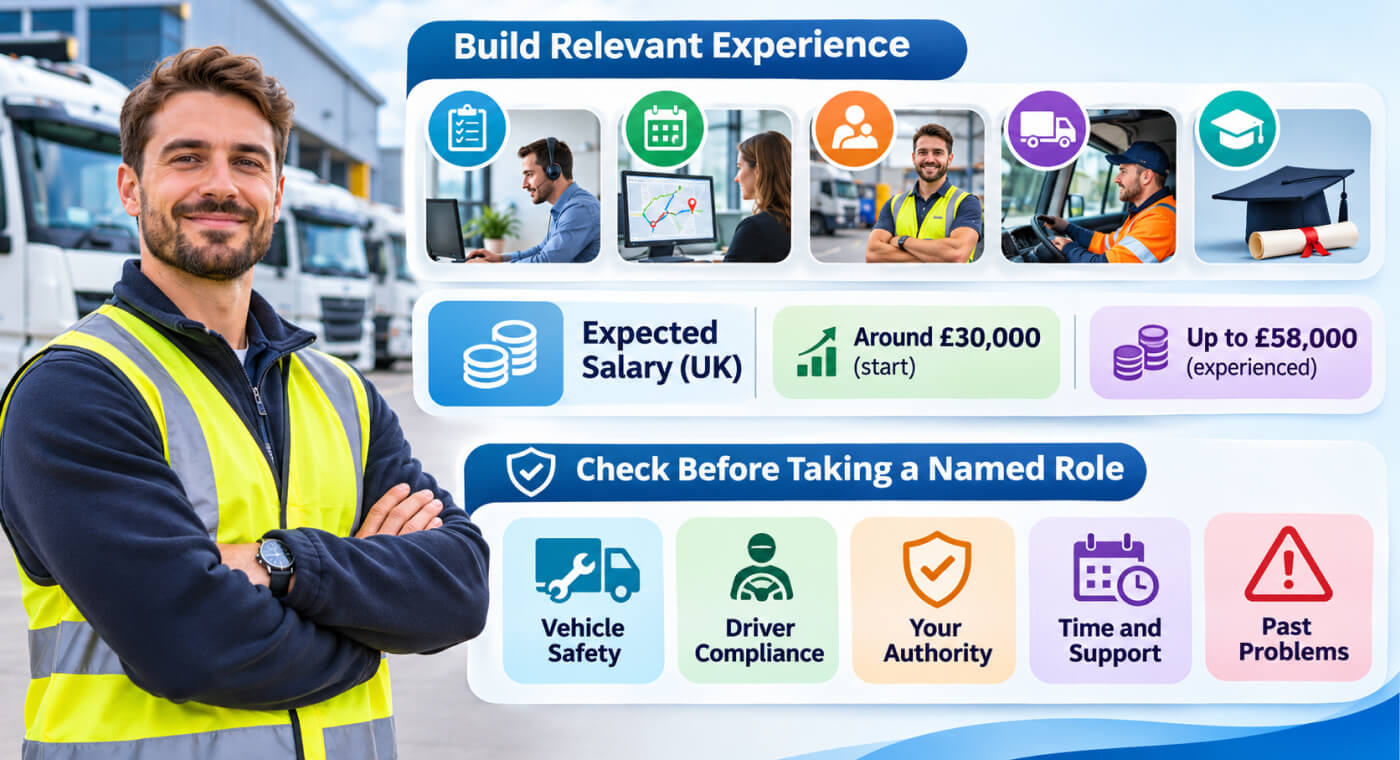
At work, gain experience checking driver schedules, using fleet software and reading repair records. Also, learn how vehicle costs affect routes. Ask experienced managers why delivery plans sometimes change. These skills give you useful examples for job interviews. According to the National Careers Service, starters earn around £30,000 a year, rising to £58,000 for experienced managers. However, pay depends on your role, location and employer.
Before accepting a named role, check whether the company offers proper support:
- Vehicle Safety: Does it fix faults and keep inspection records?
- Driver Compliance: Are driving hours, licence checks and tachograph records correct?
- Your Authority: Can you stop an unsafe vehicle?
- Time and Support: Will you have enough hours and access to staff?
- Past Problems: Are there any unresolved licence warnings or safety concerns?
For example, imagine an owner wants to send out a lorry with faulty brakes. You must have the power to stop it, record your concerns and make sure repairs are safe. Serious failures can lead to a public inquiry or even a ban. If you leave your role, you must inform the Traffic Commissioner within 28 days. The company must also report important changes.
Final Thoughts: Is Becoming a Transport Manager Right for You?
Learning how to become a transport manager is the first step towards a career with real responsibility. Beyond earning your CPC and gaining approval, you’ll need sound judgement, strong planning skills and a commitment to road safety. Every decision matters, from keeping vehicles roadworthy to making sure drivers follow the rules.
If you enjoy solving problems, organising transport operations and taking responsibility, this career could be a good fit. Start by choosing the right CPC qualification, explore your training options and build practical experience. With the right knowledge and preparation, you can take a confident step towards your first transport management role.
FAQs About how to become a transport manager
1. How Hard Is It to Become a Transport Manager?
It can be challenging because the two CPC exams test transport law, vehicle safety and business management. However, regular study and exam practice can help you pass.
2. What Qualifications Do You Need for a Transport Manager?
Most new applicants need a Transport Manager CPC in road haulage or passenger transport. You don’t need a degree or driving licence to take the exams.
3. How Much Does a Transport Manager Get Paid?
UK road transport managers earn around £30,000 at entry level and up to £58,000 with experience, according to the National Careers Service.
4. Can You Be a Transport Manager Without a CPC?
Usually, no. However, recognised older qualifications or valid acquired rights may allow you to work as a nominated transport manager.
5. How Much Does a Transport Manager CPC Course Cost?
CILT lists training prices from £1,125 to £1,980 for non-members, depending on the study method. Other providers may charge different fees.
6. Can I Be My Own Transport Manager?
Yes, you can manage your own transport business if you meet the legal requirements. For a nominated role, you also need the required qualification and regulatory approval.