
For over a decade, I have evaluated clinical workflows, managed bottom-line metrics, and streamlined shattered backend operations. The operational infrastructure of healthcare administration is currently experiencing its most volatile shift in thirty years. Medical billing services are no longer back-office cost centers; they are now frontline strategic assets.
In managing revenue cycle operations across diverse provider networks, the truth becomes obvious very quickly. The old manual ways of managing claims do not work anymore. Facilities clinging to manual data entry are hemorrhaging cash because systemic changes require deep technological integrations.
Reality of Revenue Cycle Management
The modern revenue cycle management architecture requires an absolute shift away from human guesswork. As Dr. N. R. Iloanusi notes in Artificial Intelligence for Healthcare Revenue Cycle Management: The Art of the Science, “Automated systems yield a 5% to 30% improvement in critical administrative metrics, including first-pass acceptance rates.” When your cash flow depends on clean claims, a thirty-percent bump completely alters your financial runway.
Why does this shift matter on the ground? The answer lies in structural errors. Traditional healthcare administration relies on human coders reading complex physician notes, matching them to ICD-10 codes, and manually populating claims. This process is slow. It is highly prone to fatigue.
Consider these immediate technical benefits:
- Systems eliminate repetitive manual data entry.
- Software flags missing insurance identifiers instantly.
- Claims cross-reference clearinghouse rules automatically.
- Code selections match clinical documentation perfectly.
- Prior authorization tracking happens in real-time.
- Denials get routed to specialists immediately.
When we look at the macro numbers, the impact of these automated platforms becomes clearer. In his extensive research paper, Leveraging Artificial Intelligence for Enhanced Revenue Cycle Management in the United States, Dr. V. Kilanko points out that “Predictive analytics reduce patient billing complaints by 40% while decreasing care deferrals due to financial transparency issues.” If patients understand what they owe before treatment, they pay faster, which drastically cuts down on your days in accounts receivable (A/R).
What Clean Medical Billing Actually Looks Like
Let’s talk about the actual code generation phase. For years, billing teams argued with physicians over illegible modifiers or incomplete charts. The introduction of natural language processing has changed what we spend our time on.
- Natural language processing parses clinical notes.
- Algorithms suggest appropriate modifier combinations.
- Software scans electronic health records instantly.
- System updates reflect new regulatory rules.
- Digital claims upload without human touches.
- Billing rules update overnight across networks.
This is not just an American phenomenon either. Technology is changing things globally. As Dr. L. K. Nasser observes in The Evolution of Automated Medical Billing With Artificial Intelligence, “Automated coding platforms map clinical prose directly into standardized global billing frameworks, facilitating fraud detection and legal compliance.” If you operate a multi-facility enterprise, standardized automation is the only way to maintain compliance across different jurisdictions.
That Annoying AI Arms Race Between Payers and Providers
Here is something most tech vendors will not tell you about. While providers are buying advanced RCM tech to optimize their submissions, insurance companies are buying equally powerful algorithms to deny them. It is a literal tech war that the healthcare administration has been dragged into.
In her groundbreaking paper published in Health Affairs, The AI Arms Race In Health Insurance Utilization Review: Promises Of Efficiency And Risks Of Supercharged Flaws, Professor Michelle M. Mello reveals that “Thirty-seven percent of insurers use AI for prior authorizations, and forty-four percent use it for claims adjudication.” She also warns that automated insurance systems often deny claims in batches, leading to a finding that nearly one in five Medicare Advantage denials should have legally been approved.
This means your medical billing services must be sophisticated enough to counter programmatic denials. If a payer uses an algorithm to find a tiny charting flaw, your system must use predictive analytics to ensure that flaw never leaves your building. You cannot bring a knife to a laser fight.
Operational Trade-offs: Tech vs. Tradition
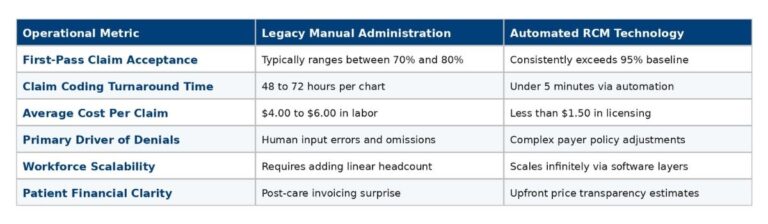
To help you visualize where to invest your capital, let us lay out the stark differences between legacy systems and modern, automated administrative platforms.
Fixing Worker Burnout Without Breaking Things
We hear a lot about clinical burnout, but administrative burnout is just as dangerous. If your billing staff spends eight hours a day doing mind-numbing data entry, they will quit. Technology must be used to lift that heavy burden.
- Systems take over low-value clerical tasks.
- In-box management gets automated via software.
- Automated notes structure physician charting inputs.
- Staff focus entirely on complex appeals.
- Redundant administrative workflows disappear completely.
- Digital tools reduce employee mental fatigue.
As researcher A. J. Nicholas writes in Healthcare Administration and AI: Enhancing Personalized Care and Workforce Sustainability, “Administrative AI structures function as a support system, reducing the administrative overload directly tied to clinician burnout.” By automating the baseline medical billing services, your highest-paid employees can focus on actual problem-solving instead of shuffling digital paperwork.
However, do not assume that throwing software at a broken process solves everything. Sometimes it makes things worse. In his study, From bedside to bytes: the digital transformation of the healthcare workforce, Dr. Y. Kyratsis warns that “Digital transformations often redistribute administrative burdens unequally, sometimes concentrating intense tech-surveillance, rigid algorithmic management, and steep learning curves onto lower-status administrative and billing staff.” If you don’t support your front-line billing clerks during a software rollout, your tech investment will fail miserably.
Big Picture View
Healthcare administration does not change in a vacuum. It follows broader economic trends that cross every single industry vertical. In his cross-sector analysis, Embracing Gen AI at Work, H. James Wilson notes that “Over 40% of all U.S. work activity can be augmented or automated by generative AI, with healthcare administration trailing just behind legal and banking sectors.” He emphasizes that “Ad-hoc, unguided usage of AI tools leads to poor reasoning outcomes,” which reinforces the absolute necessity for specialized, professional human-in-the-loop oversight.
- Humans must review automated coding suggestions.
- Software requires constant compliance audits regularly.
- Managers must monitor automated denial trends.
- Staff need continuous system training programs.
- Technical oversight remains a daily necessity.
If you run a medical practice or a hospital network, technology is your only path to survival. Relying on legacy medical billing services is a financial death sentence. Implement automated RCM frameworks, protect your staff from bad rollouts, and build a tech infrastructure that forces insurance companies to pay you what you are owed.