
Your fake nails might still look perfect but does that mean they should stay on? Not always. So, how long does artificial nails last? Press-ons can last a few days, while some glue-on sets last up to two weeks. Acrylic and hard gel extensions often need infills after two to three weeks. However, wear time depends on the nail type, application and daily habits.
Here’s something many people don’t know. Artificial nails can still feel firmly attached even when they need care. As your natural nails grow, poor fit or lifting can affect how long fake nails last. So knowing what to look for can help prevent damage. It also helps you know when your nails need attention.
Now, let’s dive in and explore how long each type lasts, what affects wear time and when your nails need attention.
How Long Does Artificial Nails Last by Type?
Artificial nails have different wear periods because they use other materials and ways to stick. Salon tips differ from press-ons. For acrylics, the time often means until an infill, not full removal. For press-ons, it means how long the glue or tabs hold. Know which figure you are reading.
| Artificial Nail Type | Wear Time | What to Do |
| Acrylic | 2–3 weeks | Get an infill |
| Hard gel | 2–3 weeks | Get a maintenance check |
| Gel-X | 3–4 weeks | Check for lifting |
| Dip powder | 2–3 weeks | Remove and renew |
| Glue-on press-ons | Up to 14 days* | Replace if loose |
| Pre-glued press-ons | Up to 10 days* | Remove as directed |
| Adhesive-tab press-ons | Varies by product | Remove when tabs loosen |
These wear times can help you plan but they are not guaranteed or safe limits. Even a new nail needs attention if it starts to come loose. Also, your natural nails keep growing under salon extensions. However, press-on nails mainly depend on how well they fit and stick. So, if a nail lifts or hurts, get it checked rather than waiting. The condition of your nails matters more than how long you have worn them.
Acrylic Nails
Acrylic nails often need an infill after two to three weeks. Your own nail grows, leaving a gap near the cuticle. An infill fills that growth area and helps restore the extension’s shape. It does not automatically mean replacing the entire set. With good care, one sound set can outlive several visits.
Hard Gel and Gel-X Nail Extensions
Hard gel extensions often need a check and rebalancing after two to three weeks. Gel-X uses full-cover soft gel tips instead. Some Gel-X systems claim around three to four weeks of wear. Yet filling or replacing them depends on the system and nail health. Gel polish coats your own nail; it does not add a full extension.
Dip Powder Nails
Dip powder nails often look good for two to three weeks. Their hard finish does not halt the growth beneath it. Some keep their finish longer but growth still shows. Dip powder often strengthens the surface of natural nails without adding length. Some systems need a fresh coat, not a fill.
Press-On Nails With Glue or Sticky Tabs
Some glue-on press-ons claim wear of up to 14 days. People often call press-ons false nails. But the same pack can wear differently on two people. Pre-glued nails have their own stated wear periods, sometimes up to ten days. Separate sticky tabs often suit short wear. Yet those claims are not an average for everyone. Fit and glue matter more than the box claim.
Why Can Artificial Nails Stay Attached Even When They Need Attention?
A fake nail can stay on even when its shape or condition changes. There are three things to look at. Appearance means how long your nails look fresh. Attachment means how long they stay firmly in place. Maintenance means when they need care from a nail technician. These three things do not always happen at the same time, especially with long acrylic or gel nails.
As your real nails get longer, a small gap starts to show near the cuticle. However, this does not mean your fake nails have started lifting. Lifting happens when the fake nail starts to come away from your real nail. You might notice a loose edge that catches on your hair. Unlike normal nail growth, this needs attention sooner and might need more than a simple infill.
There is one more detail. A long tip carries stress at certain points. As your nail grows, that balance shifts towards the tip. As a result, a grip or knock can put stress in a new place. A nail tech can restore the shape, even when the set feels firm. This is more than a fresh coat of colour.
Why Do Fake Nails Lift Early and How Can You Make Them Last Longer?
Fake nails can lift early if they do not fit or stick well. However, this does not always mean the nails are poor quality. Sometimes, one nail comes loose while the others stay firmly in place. But why does this happen? Even a small difference in nail size or shape can affect how well it sticks. So, proper nail preparation and care can help fake nails last longer. Simply adding more glue will not always fix the problem.
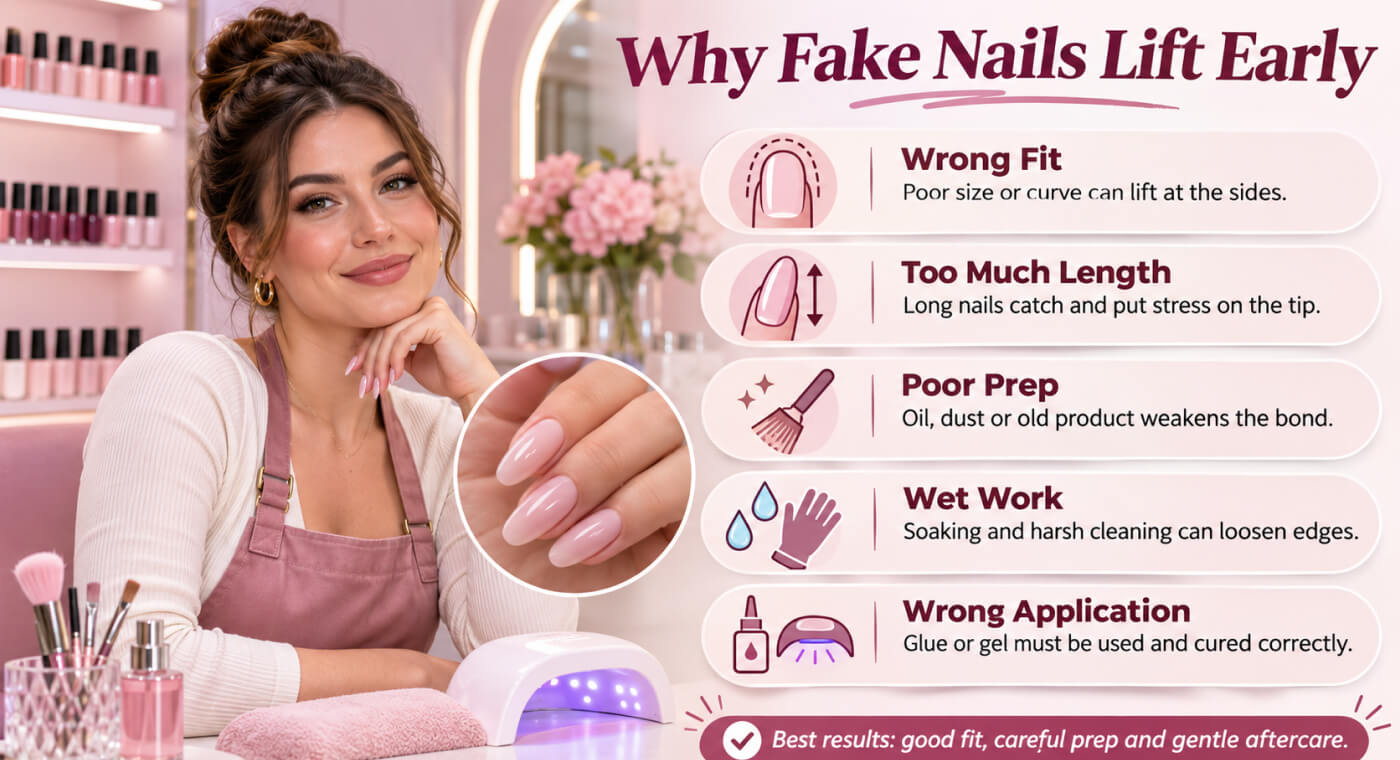
- Incorrect size or curve: A narrow tip can pull at the sides. One that is too wide might overlap the skin. Similarly, a strongly curved tip might not sit well on a flat nail. Choose a tip that fits with ease. More glue cannot fix a poor fit.
- Too much length: Long nails catch on clothes and handles. Pressure at the tip travels back towards the natural nail. In practice, short nails suit people who type, lift boxes or work with their hands. Choose a shape that feels easy to use.
- Poor preparation: Oil, dust or old product can weaken attachment. However, aggressive filing creates a different problem by thinning the natural nail. Clean the surface as the product instructs and avoid cutting into healthy skin. A nail tech can avoid rough filing.
- Repeated wet work: Washing your hands normally is fine. Long soaking and harsh cleaning can strain nails and skin. Frequent washing up can expose loose edges. Wear suitable gloves for wet chores and dry your hands carefully afterwards.
- Wrong application or curing: Nail glues and gel systems have different instructions. Using more product does not always create a stronger bond. Gel needs the right lamp and cure time. Gel that has not set well can leave chemicals that irritate skin. If you are unsure, ask a trained nail tech.
How Often Do Acrylic and Gel Extensions Need Infills?
Generally, acrylic and hard gel nails that allow infills need them every two to three weeks. An infill does more than cover the gap left by nail growth. Your nail technician checks how well the nails are attached, reshapes the tips and makes sure they stay balanced. However, some people’s nails grow faster than others, so they need infills sooner. The best time depends on your nail growth, not how long you can make them last.
An infill only works when the old set has a sound base. A nail tech should check cracks, loose edges and your nail. Meanwhile, full-cover soft gel tips and dip powder do not always use the same refill process. Some need a fresh set, not a fill. Ask what works for your nail type.
Can Acrylic Nails Last Six to Eight Weeks Without Infills?
Acrylic nails can last for weeks with regular infills and care. However, this does not mean you should leave them untouched for that long. As your natural nails grow, the extensions can lose their balance and need attention sooner. Also, a lifting edge can cause problems if you ignore it. So, book regular visits with your nail technician instead of waiting too long.
What Should You Do If One Press-On Nail Falls Off Early?
One loose press-on does not always mean the entire set has failed. Each finger has its own nail shape. For example, your thumb faces more pressure than some fingers. Check the nail beneath it before putting a tip back. If you see pain, damage or strange colour, do not cover it with glue. So what should you do?
- Check your natural nail: Look for splits, tenderness or skin irritation. Nail health matters more than matching tips. If it hurts, leave the nail bare and seek advice.
- Inspect the fallen tip: Check for cracks, bent edges or old glue. Do not reuse a damaged tip. Do not force a broken nail back into place.
- Try the right fit: Check the press-on against your nail’s width and curve. A new size could fit better. Yet it should never pinch or press the sides.
- Read the reuse instructions: Some tips can be worn again but many are single-use. Old adhesive can affect how the tip sits. Clean or replace it as the maker says.
How Can You Tell Whether Artificial Nails Need an Infill, Repair or Removal?
Look at what has changed, not only how many weeks have passed. A clean growth gap is different from a lifted edge. Similarly, worn polish is different from a crack running through an extension. Each issue needs its own response. These signs show when a fill, repair or removal fits. Ask for a check if you cannot tell the difference.
- Clean regrowth near the cuticle: If the product remains fully attached, an infill might be suitable for a refillable system. A nail tech can check its balance. Do not fill gaps yourself.
- A small surface chip: A small mark might need a quick fix. However, a chip that reaches a deep crack needs assessment. A clear coat does not repair a weak structure.
- A lifted edge or pocket: Book a check. Do not seal the loose part with glue. Water or dirt can collect in a space beneath the product. Covering it hides the loose bond.
- Pain, deep cracks or repeated lifting: Stop pressing on it and book a nail check. Repair or removal might be needed. Avoid pulling the enhancement away, even when part of it already feels loose.
- Unexpected colour or swollen skin: Do not apply another enhancement over a suspicious change. Redness, heat, swelling or strange colour needs medical advice. A green or yellow mark alone cannot tell you the cause.
When Is a Fresh Set Better Than Another Infill?
A new set makes sense when the old one cannot hold a sound repair. Wide damage can rule out another infill. Some nails need removal and time bare. A nail tech can check the set. Strange changes to your nail need medical advice.
There is one key difference to know. Product lifting happens when the fake nail starts to come away from your real nail. However, natural nail separation happens when your real nail lifts from the skin underneath. Both problems need different care. According to the NHS guidance on nail problems, you should see a GP if your nails change in an unusual way or the skin around them becomes sore and swollen.
Can Wearing Artificial Nails Too Long Damage Your Natural Nails?
Keeping a set on too long without care can put stress on your own nail. A loose edge can catch, pull and widen a gap. Pulling nails off can strip surface layers. However, damage is not inevitable with every set. Good prep, timely checks and gentle removal all help. Pain is not normal wear.
Allergy is a separate issue. It does not happen simply because a manicure passes a certain number of weeks. Some nail chemicals can irritate skin or cause an allergy. Gel that has not set well poses an extra risk. The UK’s Health and Safety Executive warns about skin allergies linked to chemicals in artificial-nail systems.
So, what signs should you look for? Itching, redness, swelling or cracked skin can mean a reaction. The NHS guidance on contact dermatitis explains these signs and when to get help. Also, if your nails feel weak or sore, leave them bare until they heal. However, not everyone needs the same amount of time to recover.
How Should You Remove Artificial Nails Without Unnecessary Damage?
Different nail types need their own removal methods. Pulling or peeling them off can damage your own nail surface. Even similar-looking sets need their own steps. So, check the actual system before using acetone, filing or a press-on remover. If unsure, see a nail tech. Do not test removal by tugging at one corner.
- Acrylic extensions: Acrylic needs care during filing and removal. A nail tech can help protect your own nail. Never prise an attached section off just because the edges have started to lift.
- Hard gel extensions: Some hard gels do not soak off with acetone. They need careful filing by a nail tech. Treating hard gel like gel polish risks over-filing.
- Soak-off gel and dip powder: These systems need the correct remover and enough time to soften. Check the product steps. If the coating resists, do not scrape it away with force.
- Press-on nails: Glue-on tips and sticky tabs need different steps. Follow the maker’s instructions and work gently. Pulling a firm tip off can take layers of your natural nail with it.
Final Thoughts: When Should You Refresh or Replace Your Artificial Nails?
A perfect-looking manicure does not always mean your nails are ready for another week. When asking how long does artificial nails last, look beyond the usual wear times. A small growth gap might only need an infill. However, lifting, cracks or discomfort can mean it’s time for a repair or removal.
The key is knowing when to keep your nails and when to let them go. After all, getting an extra week from your manicure means little if it damages the nails underneath.
Can you spot when acrylic nails need an infill rather than a new set? Take your nail skills further with our Acrylic Nail Course and explore the techniques behind acrylic application and maintenance.
FAQs About How Long Does Artificial Nails Last
1. How Often Do Fake Nails Need to Be Replaced?
Acrylic and gel extensions often need a fresh infill every two to three weeks as natural nails grow. Press-on nails often need replacing sooner, while damaged or lifting nails need prompt attention.
2. What Is the Healthiest Fake Nail Option?
Soak-off gel nails can be gentler than acrylics because they are more flexible. However, no artificial nail is completely risk-free and proper application and removal matter most.
3. Do Fake Nails Ruin Real Nails?
Fake nails can weaken natural nails through excessive filing, poor application or forced removal. However, careful application, regular maintenance and gentle removal can reduce the risk of damage.
4. What Is Worse for Nails, Acrylic or Gel?
Acrylic nails often require more filing and create a harder, less flexible extension. Soak-off gel can be gentler but both systems can cause damage or allergic reactions.
5. What Is the Healthiest Nail Option at a Salon?
A traditional manicure with regular nail polish is generally gentler than acrylic or gel extensions. Choose a clean salon that uses safe products and avoids aggressive filing or cutting cuticles.
6. Are Nails Healthier Without Polish?
Healthy nails do not need to remain bare all the time. However, leaving off polish can help damaged nails recover and make it easier to spot changes.

Acrylic nails Course
Course Description :
- Certificate: Yes(Free)
- Accreditation: CPD Accredited
- Access: Lifetime