
AET can help you learn how to teach, but it does not open every classroom door. So, you might be thinking, “Can I teach with AET Level 3 when I finish the course?” Yes, you can explore adult teaching, workplace training and vocational tutor roles. However, your subject knowledge, experience and employer requirements also matter. The Level 3 Award in Education and Training (AET) does not qualify you for every teaching job. For example, it does not provide Qualified Teacher Status (QTS) for maintained schools in England. Some college and specialist teaching roles also require further qualifications.
Now, let’s take a closer look at where AET Level 3 can take you, what you can teach and where you may need more qualifications.
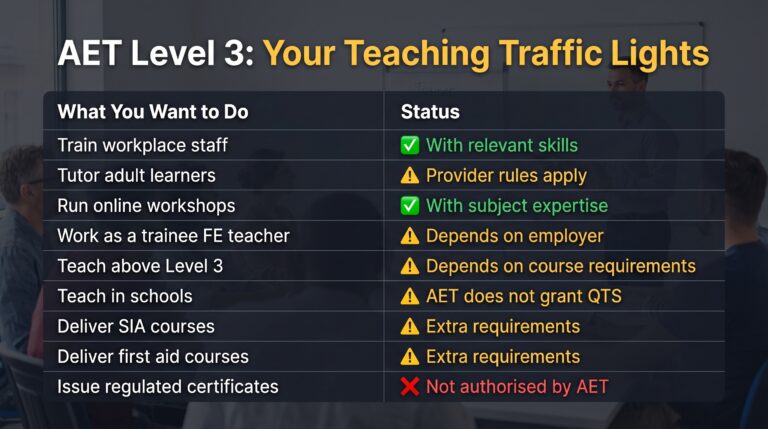
Can I Teach With AET Level 3 in the UK?
Yes, Level 3 AET can help you start teaching or training in suitable roles across the UK. It is an introductory qualification for people developing their teaching skills. You learn how to plan lessons, support learners and check their understanding. However, AET does not qualify you to teach every subject or take any teaching job.
The key difference is between knowing how to teach and knowing what to teach. AET develops your teaching skills, while your qualifications and work experience show your subject knowledge. Employers then check whether you meet their job requirements. For example, an experienced care worker with AET could train other care staff. Someone without care experience would need more subject knowledge.
Teaching requirements also depend on the role and where you work in the UK. This guide uses England’s official further education (FE) and school rules where relevant. Before applying, check the requirements for your chosen teaching role. Do not assume your AET qualification alone meets every condition.
What Subjects Can You Teach With a Level 3 AET Qualification?
With a Level 3 AET qualification, you can teach subjects linked to your existing skills and experience. However, you must also meet the requirements for your chosen subject and teaching role. AET helps you plan and deliver lessons but it does not prove your subject knowledge. So, what subjects could you teach? Here are five areas where your AET skills could help.
- Workplace skills: Train staff in customer service, teamwork, daily tasks and safe working practices. You must also understand the job and workplace rules.
- Security and safety: Teach suitable safety topics or support security training. However, SIA licence-linked and first aid courses have additional requirements.
- Health and social care: Train care staff in daily care routines, record-keeping, and safe working practices. Specialist training requires suitable knowledge and skills.
- Construction and trades: Teach practical skills in building, equipment use or a trade you know well. Some technical courses require additional qualifications or experience.
- Beauty and personal care: Teach hairdressing, nail care or beauty skills within your area of expertise. Training providers might also require relevant qualifications or recent experience.
For example, imagine two people with the same Level 3 AET qualification. One has years of experience as a bricklayer, while the other has none. Although both have AET, their knowledge of bricklaying is different. That is why training providers consider both teaching skills and subject knowledge before accepting someone as a trainer.
Where Can You Teach With an AET Qualification?
With an AET qualification, you can explore teaching roles in workplaces, private training centres and adult education settings. It can also support entry into some further education (FE) roles. However, each workplace has its own teaching requirements. For example, a college might offer short trade courses and full-time teaching jobs. Both roles could require different qualifications and experience.
| Teaching Setting | Possible Teaching Work | What Else You Need |
| Workplace | Staff training and short sessions | Job skills and employer requirements |
| Private training provider | Vocational and workplace skills courses | Subject knowledge and provider approval |
| Adult learning centre | Adult education and community classes | Meet the centre’s entry requirements |
| FE college | Trainee teaching or vocational training roles | Industry skills and further teacher training |
| School | Roles that meet school-specific rules | AET alone does not provide QTS |
The best place to start depends on your existing skills and experience. For example, if you know a trade, look for training providers that teach it. Similarly, if you already train colleagues, check for training roles within your company. This way, you can focus on suitable opportunities instead of applying for every teaching job.
Can You Teach in a College With Level 3 AET?
Yes, Level 3 AET can help you apply for some college teaching and training roles in the UK. However, it does not qualify you for every lecturer position. Further education (FE) colleges offer courses ranging from practical trade skills to GCSEs and A-levels. Because of this, teaching requirements vary by subject. Some roles need higher academic qualifications, while others value practical industry experience.
Interestingly, you do not always need a teaching qualification before starting an FE job. Some colleges hire experienced professionals and support their teacher training while they work. Similarly, many vocational teaching roles do not require a university degree. The Department for Education explains these requirements. When searching for jobs, look for terms such as “trainee lecturer” or “training provided”.
Can You Teach in Schools With Level 3 AET?
No, Level 3 AET alone does not qualify you to become a fully qualified school teacher. It does not provide Qualified Teacher Status (QTS), which maintained schools in England normally require. This applies to teaching roles in maintained primary, secondary and special schools. However, school teaching has different requirements from adult education and workplace training. So, you should check the rules for your chosen school.
Academies and independent schools have had different QTS requirements, although many prefer qualified teachers. These rules can also change, so check the current government QTS guidance before applying. Also, remember that a Postgraduate Certificate in Education (PGCE) and QTS are different. Completing Level 3 AET alone does not give you either qualification.
Can You Teach Above Level 3 With an AET Qualification?
Yes, you could teach courses above Level 3 with an AET qualification, depending on the teaching requirements. However, AET alone does not qualify you to teach higher-level courses. The Level 3 in AET refers to your teaching qualification, not the highest course level you can teach. Your subject knowledge, experience and the training provider’s requirements also matter.
For example, an experienced technician with Level 3 AET could have strong knowledge of a specialist trade. A training provider might consider that person for a suitable teaching role. However, a full further education (FE) teaching position could require a Level 5 teaching qualification. This shows why the level of your teaching award differs from the level of the course.
So, what should you check before teaching? Start by looking at the requirements of your chosen course. Check the subject knowledge, teaching qualifications and assessment skills the provider expects. Remember, your AET qualification level alone does not decide which courses you can teach.
Do You Need Other Qualifications Besides Level 3 AET?
Yes, some teaching roles require additional qualifications, skills or experience alongside Level 3 AET. However, the exact requirements depend on your subject, employer and training provider. AET gives you basic teaching knowledge but it does not prove your skills in every subject. Similarly, it does not automatically qualify you to assess regulated courses. Here are five areas to check.
- Subject knowledge: You need to understand the subject you plan to teach. Relevant qualifications, previous study or proven skills can help show your knowledge.
- Industry experience: Many vocational teaching roles require practical experience in the relevant field. Training providers might also expect recent work experience.
- Assessment skills: Teaching and assessing regulated qualifications can require different skills. Some assessment roles also need separate qualifications or evidence of competence.
- Specialist certificates: Subjects such as security and safety can require additional instructor qualifications. Check the specific course requirements before applying.
- Employer checks: Some roles require safeguarding checks, English and maths skills or other workplace conditions. These requirements vary between employers and teaching settings.
Before applying, read the teaching job requirements carefully. If anything is unclear, ask which teaching qualifications, subject skills and assessment experience the employer accepts. This will help you identify any gaps in your qualifications. You can then focus on the training you actually need instead of spending money unnecessarily.
Can You Teach SIA or First Aid Courses With Level 3 AET?
Yes, Level 3 AET can help you teach SIA licence-linked and first aid courses in the UK. However, AET alone does not meet every trainer requirement. These courses involve safety knowledge, practical skills and formal assessments. Because of this, trainers must meet the relevant qualification and experience requirements. The exact rules depend on the course you want to deliver.
- SIA licence-linked courses: The SIA accepts Level 3 AET as a teaching qualification. However, trainers also need relevant industry experience and an approved training provider.
- First aid at work: Trainers need suitable first aid knowledge and teaching skills. A current first aid certificate or certain healthcare qualifications can help prove their competence.
- Specialist safety skills: Some courses, such as physical intervention training, require additional qualifications. AET alone does not replace practical skills or specialist training.
- Course assessment: Trainers who assess learners must also meet the relevant assessment requirements. Awarding organisations can set additional conditions for these roles.
For new SIA trainers, the official SIA guidance sets clear experience requirements. Most security sectors require two years of front-line experience within the previous five years. Cash and valuables training requires 12 months within the previous three years. Similarly, HSE guidance explains the competence expected of first aid trainers. HSE no longer approves most workplace first aid training providers.
What Jobs Can You Get With Level 3 AET?
With Level 3 AET, you can explore jobs as a workplace trainer, vocational trainer, tutor or trainee FE teacher. This qualification helps you develop lesson planning and teaching skills. However, getting a job also depends on your subject knowledge, experience and the employer’s requirements. Your existing work skills can help you find a suitable teaching role.
- Workplace trainer: Train employees in daily tasks, new procedures and safe working practices. Employers also expect you to understand the work you teach.
- Vocational skills trainer: Teach practical skills in your area of expertise. Training providers often look for relevant industry experience and qualifications.
- Freelance trainer: Deliver suitable workshops or work with training organisations. However, regulated courses can have additional teaching and assessment requirements.
- Community learning tutor: Teach adults in subjects you know well. Adult learning centres set their own requirements for qualifications and teaching experience.
- Trainee FE teacher: Explore college teaching roles while developing your teaching skills. Some colleges support staff working towards higher teaching qualifications.
However, each teaching job has different duties and entry requirements. For example, delivering short workplace sessions differs from teaching full-time at an FE college. So, check the job description before applying. Look at the subject, learner age group, course level and any further training requirements. This will help you find roles that match your qualifications and experience.
Can You Teach Online With Level 3 AET?
Yes, Level 3 AET can help you teach online through live workshops, training sessions and staff webinars. However, you still need suitable knowledge of the subject you teach. Online courses can also have their own teaching and assessment requirements. For example, you could deliver a private skills workshop and provide a record of attendance. However, AET alone does not allow you to issue Ofqual-regulated qualifications. You must also meet the relevant provider approval requirements.
Is AET Level 3 a Full Teaching Qualification?
No, Level 3 AET is an introductory teaching qualification, not a full further education (FE) teaching qualification. It teaches basic skills in lesson planning, inclusive teaching and checking learners’ progress. These skills can help you deliver short courses and start certain training roles. However, AET does not cover the full range of skills expected from a qualified FE teacher.
The Level 5 Diploma in Teaching (Further Education and Skills) provides a full FE teaching qualification. In comparison, Level 3 AET and Level 4 CET have more limited purposes. However, this does not make AET less valuable. It simply supports a different stage of teaching and training. So, choose a qualification that matches your teaching role and career goals.
What Qualifications Can You Do After Level 3 AET?
After Level 3 AET, you can progress to Level 4 CET or Level 5 DiT to develop your teaching career. However, further qualifications are not always necessary for every training role. Your best option depends on your current job, teaching hours and career goals. If your employer accepts AET, you can continue teaching in a suitable role. Full FE teaching positions usually require further teacher training.
- Continue with AET: Gain practical teaching experience in roles where your current qualification meets the requirements.
- Level 4 CET: Develop broader teaching skills and prepare for roles with more teaching responsibilities.
- Level 5 DiT: Work towards the full Diploma in Teaching (Further Education and Skills).
- QTLS: Explore Qualified Teacher Learning and Skills status after gaining an eligible teaching qualification and meeting its requirements.
Importantly, you do not always need Level 4 CET before starting a Level 5 teaching qualification. The newer Level 5 DiT has also replaced the older DET for new FE teaching routes. However, completing DiT does not automatically give you QTLS status. You must complete a separate professional process and meet the relevant requirements.
So, Can I Teach With AET Level 3 and Start Working?
The real value of AET comes from putting your learning into practice. But can you start working straight away? That depends on the opportunities available and how well you meet their requirements. Start by exploring teaching jobs that genuinely interest you. Then compare their requirements with your current skills and experience. This will help you see where you are ready to apply and where you need further preparation. After all, having a clear direction matters more than collecting qualifications without a goal.
Know your subject well but not sure how to teach it? Learn how to plan and deliver lessons with the Level 3 AET Course at the School of Health Care.
FAQs
What Can I Do With AET Level 3?
- With Level 3 AET, you can explore adult teaching, workplace training and vocational tutor roles. However, your subject knowledge and experience must meet the job requirements.
Can You Be a Teaching Assistant With Level 3 Childcare?
- Yes, a Level 3 childcare qualification can help you become a teaching assistant. However, schools may ask for relevant experience or extra qualifications.
How Long Does AET Level 3 Take?
- A Level 3 AET course often takes 10–16 weeks at UK colleges. However, course length varies by provider and study method.
How Much Does a Level 3 AET Course Cost?
- A Level 3 AET course can cost around £150 to £700 or more in the UK. Fees depend on the provider, study method and assessment costs.
What Is AET Level 3 Equivalent To?
- AET Level 3 is at the same qualification level as A-levels in England. However, it is a smaller award focused on teaching and training skills.
Will a Level 3 AET Course Qualify Me?
- Yes, a regulated Level 3 AET course gives you an introductory teaching qualification. However, it does not make you a fully qualified FE teacher or grant QTS.