When we imagine the life of a Flight Attendant (or “Air Hostess” as the term was historically used), the mind often drifts to images of pristine uniforms, layovers in Tokyo or Paris, and a lifestyle of glamour. It is a career that promises the world, literally.
However, behind the curtain of the galley and the perfectly applied makeup lies a profession that is physically demanding, biologically taxing, and governed by some of the strictest regulatory frameworks in the employment world.
If you have been searching for “flight attendant salary”, “British Airways cabin crew requirements”, or “how to become cabin crew”, you are likely looking for the practical steps to get hired. But to truly succeed and survive in this industry, you must first understand the physiology of flight and the rigid medical standards you must meet.
In this comprehensive guide, we will explore the science of what happens to your body at 35,000 feet, the financial realities of the job, and the crucial “Fit to Fly” protocols that every crew member must know.
The Physiology of Flight: Working in a Hypobaric Environment
To understand why aviation medical standards are so high, we must first look at the environment in which you will be working. An aircraft cabin is an artificial environment designed to sustain life in a place where humans are not meant to exist.
The “Cabin Altitude” Factor
Cruising at 38,000 feet, the outside air temperature is roughly -55°C, and the air is too thin to breathe. Inside, the aircraft is pressurized. However, it is not pressurized to sea level. The “cabin altitude” usually simulates an elevation of 6,000 to 8,000 feet (similar to being on a mountain ski resort).
For a passenger sitting still, this is negligible. For a Flight Attendant pushing a heavy cart, securing a cabin, or performing CPR, this environment presents physiological challenges:
- Hypoxia (Mild): There is slightly less oxygen available in the blood. While safe, this contributes to “aviation fatigue,” making physical tasks more draining than they would be on the ground.
- Gas Expansion (Boyle’s Law): As the aircraft climbs and pressure decreases, gases inside the body expand by approximately 30%. This affects the stomach, the sinuses, and the ears. This physical law is the primary reason why flying with a cold or flu is not just uncomfortable—it is dangerous.
- Dehydration: The humidity in an aircraft cabin is often less than 20% (drier than the Sahara Desert). This accelerates dehydration, affecting cognitive function and physical performance.
Understanding this biology explains why airlines are so selective during the recruitment process. They aren’t just looking for good service; they are looking for physical resilience.
The ‘Fit to Fly’ Rule: When You Must Ground Yourself
In the aviation industry, showing up to work “under the weather” is not a sign of dedication; it is a safety violation. Aviation authorities (like the CAA or EASA) and airlines operate under strict “Fit to Fly” regulations.
The Danger of Barotrauma
The most common medical issue for crew is Aerotitis Media or Barotrauma.
If you have a blocked nose or inflamed sinuses due to a common cold, the Eustachian tube in your ear cannot equalize pressure during descent. As the plane lands and pressure increases, the eardrum is sucked inward. This can result in:
- Excruciating pain.
- Ruptured eardrums.
- Permanent hearing damage.
- Inability to perform safety duties.
Therefore, if you wake up with a severe head cold, you are medically unfit to operate.
The Administrative Headache: Managing Sickness Absence
This creates a dilemma for crew members. Airlines run on tight schedules with minimal spare staff (“standby”). Calling in sick is a significant operational disruption. Consequently, attendance management policies in aviation are notoriously strict.
If you call in sick (“go sick” in crew slang), you are often required to provide immediate evidence of your incapacity to work. A simple self-certification is often scrutinized heavily if it happens frequently.
This is where the logistics of modern healthcare often fail the dynamic lifestyle of aircrew. Waking up at 4:00 AM with a blocked ear before a flight to New York leaves you with few options. You cannot fly, but waiting three days for a GP appointment to get a note is often not acceptable to management who need to roster you for the next available flight once you are recovered.
The Modern Solution for Aircrew
To bridge the gap between strict airline requirements and the slow speed of traditional healthcare, many aviation professionals now utilize telemedicine. Rather than sitting in a waiting room (and risking catching a secondary infection), crew members often use online services to obtain a sick note.
These services allow you to have a consultation with a registered doctor via a secure digital platform. If deemed unfit for duty, you receive a verifiable medical certificate or fit note quickly. This provides the airline with the official documentation they require for your personnel file, proves you are adhering to safety protocols by not flying while unfit, and allows you to rest at home rather than navigating the healthcare system while ill.
Note: Always check your specific airline’s operations manual regarding sickness reporting, but know that valid medical evidence is your best defense in attendance reviews.
Financial Altitude: Flight Attendant Salary Guide (UK & Global)
One of the most searched terms on our platform is “flight attendant salary”. It is a complex topic because, unlike a typical 9-to-5 job, aviation pay is structured in layers.
When analyzing job offers, it is vital to look beyond the “Basic Pay.” Here is how the compensation usually breaks down:
1. Basic Salary
This is your guaranteed monthly income, regardless of how much you fly.
- Budget Airlines: £14,000 – £18,000 per year.
- Legacy Carriers (e.g., British Airways, Virgin): £18,000 – £24,000 per year.
2. Flight Pay (Hourly Pay)
You are paid an additional hourly rate from the moment the aircraft creates movement (chocks off) to the moment it stops (chocks on).
- This can add £300 – £800 to your monthly take-home pay, depending on your roster.
3. Allowances (Per Diems)
When you stay overnight in a foreign destination, the airline pays you an allowance for meals and expenses. In tax terms, this is often tax-free.
- A night in New York or Tokyo can generate significant tax-free income.
4. Commission
On low-cost carriers (like Ryanair or easyJet), commission from selling duty-free products, food, and scratch cards can make up a substantial part of your salary (sometimes up to £300+ a month).
Total Realistic Earnings:
- Junior Cabin Crew: £20,000 – £26,000
- Senior Cabin Crew / Cabin Manager: £30,000 – £45,000
- Corporate/Private VIP Jet Crew: £50,000 – £100,000+ (This is the top tier of the industry).
Essential Requirements: Do You Have What It Takes?
Before you can earn that salary, you must pass the recruitment stage. Aviation is competitive. For every successful applicant, dozens are rejected. Here are the core requirements you generally need to meet.
Physical Requirements
- Height: You must be able to reach emergency equipment in overhead lockers. Usually, a minimum height of 157cm-160cm is required (or a “reach test” of 212cm on tiptoes).
- Vision: You must meet the standard for visual acuity (with or without glasses/contacts).
- Swimming: You must be able to swim at least 25 meters unaided. This is non-negotiable for ditching (water landing) scenarios.
- Appearance: No visible tattoos while in uniform. This is a strict rule for Middle Eastern and most Legacy carriers.
Educational and Soft Skills
While you don’t always need a university degree, you do need to demonstrate specific competencies. This is where The School of Healthcare can give you the competitive edge.
Recruiters are looking for evidence of:
- Safety Awareness: Can you handle an emergency without freezing?
- First Aid Knowledge: Can you manage a passenger having a heart attack or a seizure?
- Customer Service: Can you de-escalate a situation with an angry passenger?
How Training Can Launch Your Career
Many applicants enter the interview room with just a high school diploma and a smile. While a smile is essential, it doesn’t prove competence.
Investing in relevant qualifications before you apply shows the airline two things: you are serious about the career, and you already possess the foundational knowledge they need.
Recommended Courses for Aspiring Cabin Crew
At The School of Healthcare, we offer several CPD-accredited courses that align perfectly with aviation recruitment standards:
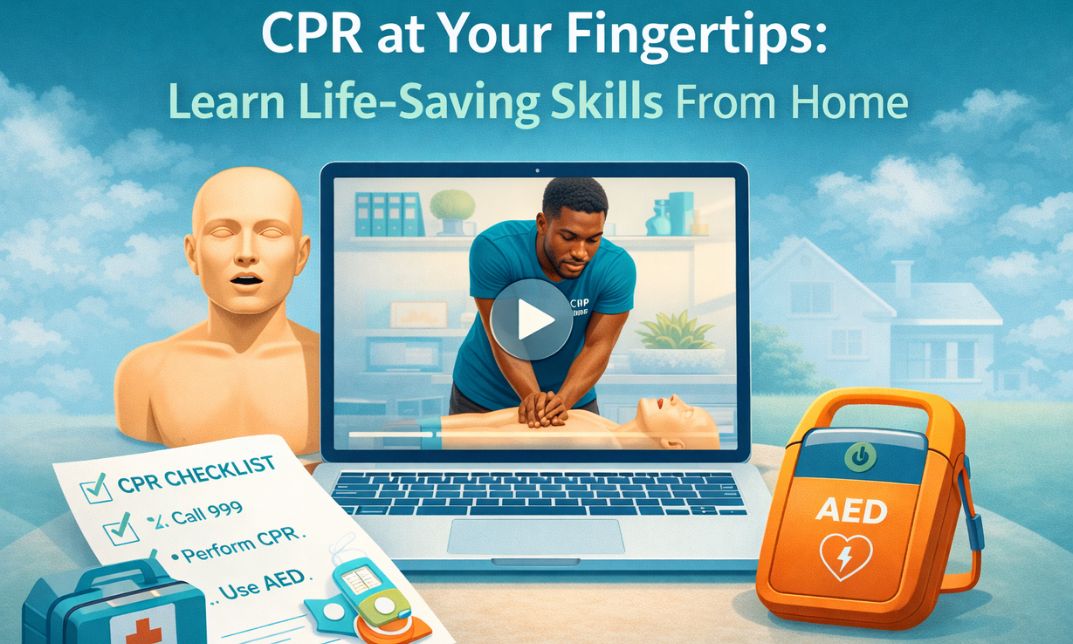
- First Aid & CPR Training: Airlines conduct their own training, but having a prior certificate proves you have the aptitude for medical emergencies.
- Health & Safety (Level 2 or 3): Understanding risk assessment is a huge part of the crew’s job.
- Customer Service & Conflict Resolution: Essential for managing difficult situations at 35,000 feet.
- Manual Handling: Luggage and carts are heavy. Understanding TILE (Task, Individual, Load, Environment) principles protects your back and appeals to airline safety recruiters.
Preparing for Take-Off
A career as a flight attendant is an adventure that offers lifestyle benefits few other jobs can match. However, it requires a unique blend of physical health, mental resilience, and professional training.
From understanding why you can’t fly with a cold to knowing how to legally and quickly obtain an online sick note to protect your license, professional crew members are those who take their health and their career seriously.
If you are ready to earn your wings, don’t just wait for an interview. Build your CV, improve your skills, and prove to the recruiters that you are already thinking like a safety professional.
Ready to boost your CV? Explore our [Health, Safety, and Care Courses] today and take the first step toward your new office in the clouds.