
Fair workplaces do not happen by chance. They need clear rules, fair decisions and regular checks. That is why knowing how to promote equality and diversity in the workplace matters. Employers should make hiring, pay, training and promotion fair for everyone. They should also remove hidden barriers, offer reasonable adjustments and prevent harassment.
Equality gives people fair access to work and opportunities. Diversity brings together people with different backgrounds, skills and views. Inclusion then helps those people take part and grow without unfair barriers.
So, what should employers focus on? They need fair systems, clear accountability and simple ways to measure whether real progress is happening.
So, let’s see what employers can do to build a fair and inclusive workplace.
What Does Equality and Diversity in the Workplace Look Like?
Equality and diversity in the workplace should show in normal work. Staff should get fair access to jobs, pay, training and growth. They should also have a fair say in choices that affect them. In practice, clear rules make fair treatment easier.
Equality does not mean giving every person the same support. A disabled worker may need a change to do the job well. That change may involve hours, tools, space or the hiring process. UK law can require reasonable adjustments when a disabled person faces a major barrier.
Diversity can also go beyond the traits named in law. Staff may have different school, work or money backgrounds. They may also solve tasks in different ways. But why does that matter?
Different people can face different barriers in the same system. A rule may look fair but still harm one group more. So, good practice checks the result as well as the rule. It also checks who gets each key chance.
The importance of equality and diversity in the workplace comes from this point. A mixed workforce does not always mean a fair one. People also need fair access to support, growth and work choices.
How to Promote Equality and Diversity in the Workplace?
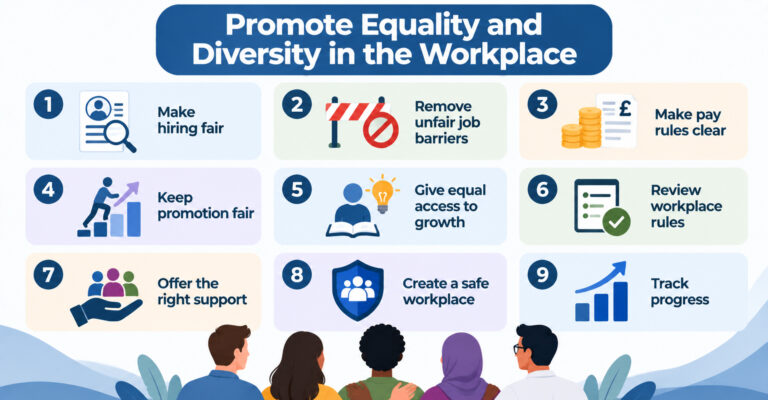
The best way is to make workplace choices fair, clear and easy to review. Good aims alone are not enough. Employers also need clear steps that people can understand and follow.
Here are nine practical ways to promote equality and diversity in the workplace:
1. Make hiring fair: Use clear job needs, set questions and the same scoring rules.
2. Remove unfair job barriers: Ask only for skills and experience the role truly needs.
3. Make pay rules clear: Staff should understand how pay, bonuses and rewards work.
4. Keep promotion fair: Show what skills and results staff need to move forward.
5. Give equal access to growth: Check who gets training, mentoring and key projects.
6. Review workplace rules: Check hours, dress rules and work patterns for hidden unfairness.
7. Offer the right support: Use reasonable adjustments and flexible working where needed.
8. Create a safe workplace: Prevent harassment and give staff clear ways to raise concerns.
9. Track progress: Give each action an owner, deadline and simple measure of success.
A goal such as be more inclusive is too vague. Instead, say what should change and by when. Also name the person who will lead the work. This makes progress much easier to check.
For example, a firm may want fairer access to training. It can track who gets places over six months. Managers can then look for clear gaps. If one group misses out, they can find out why.
Practically, each action needs a clear owner and target. It also needs a simple way to measure progress. This keeps equality work active instead of leaving it as a written promise.
How Can Fair Hiring Reduce Bias?
For many firms, how to promote diversity in the workplace starts with fair hiring. A vague job ad can put good people off. A loose interview can also give personal views too much weight. So, what should a firm do?
- Cut weak job rules: Ask only for skills the role truly needs.
- Set clear needs: Agree key skills before people apply.
- Use set questions: Ask each person the same core interview questions.
- Offer support: Make tests and interviews easy to access.
- Write down reasons: Keep short notes on each hiring choice.
Job ads should use plain words and real job needs. Long wish lists can put good people off. Vague terms can also hide what the firm wants. Clear terms give each person a fairer chance.
For example, reliable is a vague word in a job ad. Keeps private work data safe is much clearer. Similarly, a degree may not be needed for every role. Employers should remove rules that do not link to the work.
Set interview questions can help too. The panel should agree what a good answer looks like. It can then score each person against the same guide. This cuts the effect of mood or personal taste.
Blind screening may also help at an early stage. A firm may hide names before the first review. Still, this step cannot remove every form of unconscious bias in the workplace. The full hiring process must stay fair.
Training can help staff spot bias. Yet training alone cannot fix a weak process. Clear rules, set scores and written reasons do more. Basically, awareness helps but systems shape choices.
What Should Employers Check When AI Helps Screen Candidates?
Some firms use AI to sort CVs or rank people. This can save time but it can also copy old bias. Staff should know what the tool checks and what data it uses. A person should still review key results.
Historical data may contain old unfair patterns. Because of this, AI can repeat those patterns at scale. Employers should test the tool for bias and check its limits. They should also keep clear human oversight.
Applicants should also know when AI affects the process. They should have a clear way to raise concerns. Employers should review unusual or challenged results. That gives people a way to question harmful decisions.
How Can Employers Make Pay and Career Growth Fairer?
Fair hiring is only the start. Staff also need fair access to pay, training and promotion. Hidden rules can block growth after a person joins. That can harm both trust and staff retention.
- Pay: Use clear pay ranges and check odd gaps.
- Promotion: Show the skills and proof needed for higher roles.
- Training: Check who gets courses, mentors and key projects.
- Rewards: Make bonus and pay-rise rules easy to understand.
Clear rules matter because informal news does not reach everyone. One worker may hear about a role early. Another worker may never know it exists. That is not a fair way to build careers.
Managers should also check who gets high-value work. Some staff get the same key tasks because managers know them well. That can build one career while others stay still. Fair work chances should not depend on who knows whom.
Similarly, promotion rules should be easy to find. Staff should know what skills and results count. They should also know who makes the final choice. This helps reduce hidden favour and guesswork.
Are Equal Pay and the Gender Pay Gap the Same?
No. Equal pay looks at men and women doing equal work. The gender pay gap looks at average pay across men and women. The two issues are linked but they are not the same.
Employers with 250 or more staff must report gender pay gap data. In 2026, they can also publish action plans. These plans can show how they aim to close gaps. They may become required from spring 2027.
How Can Workplace Rules Create Hidden Inequality?
Some work rules apply to every person. Yet the rule may still harm one group more. This is called indirect discrimination. The key issue is the effect of the rule.
- Work hours: Check fixed shifts, late work and strict start times.
- Job rules: Remove needs that the role does not truly require.
- Work policies: Review dress, place and work-from-home rules.
- Work choices: Check promotion, rating and redundancy rules.
Take a simple example. A firm may say every manager must work late each Friday. The rule applies to all managers. Still, it may create a bigger barrier for some staff.
So, what should the firm ask? Does the job truly need that rule? Could a less strict option meet the same need? Those two questions can reveal a hidden block.
The same issue can appear in job ads. A role may ask for ten years of work history. Yet five years may be enough to do the job well. A weak rule can cut out good people.
Some rules may still be lawful. The employer may need to show a real and valid aim. The rule must also be a fair and proportionate way to meet that aim. In simple terms, a less unfair option should be used when it works.
How Do Reasonable Adjustments and Flexible Working Support Inclusion?
Inclusion means removing real barriers where possible. A disabled worker may need a change to work well. The change may involve hours, tools, space or work tasks. It may also affect the hiring stage.
Reasonable adjustments can include changes to the hiring process. They can also include new equipment or a different work area. A worker may need flexible hours or a phased return. The right change will depend on the person and role.
Accessible communication can also make a big difference. Some staff may need Easy Read, captions or screen-reader-friendly files. Others may need written notes after a meeting. Clear formats help people take part in work and decisions.
This is one practical answer to how to promote inclusion in the workplace. Accessibility means far more than ramps or wider doors. A small change can remove a large barrier. So, employers should talk with staff about what works.
Flexible working can also support equality. Staff can ask to change hours, days or workplace. Employers must deal with requests in a reasonable way. A request can be refused for a genuine business reason.
But why does this link to equality? A fixed rule can block some people more than others. For example, late-night work may stop some staff from seeking a lead role. A fair review can test if that rule is truly needed.
How Should Employers Prevent Harassment and Help Staff Speak Up?
People need safe ways to raise concerns. A policy alone will not build that trust. Staff need clear routes and a fair response. Managers also need to spot risks before harm grows.
A firm should give staff more than one way to report a problem. It should record key facts and act in good time. Repeated cases may show a wider issue. That should lead to a deeper review.
As of September 2026, employers must take reasonable steps to stop sexual harassment. From 30 October 2026, the duty becomes stronger. Employers will need to take all reasonable steps. New rules will also cover third-party harassment.
Third parties can include clients, users or customers. So, a firm should not ignore abuse from outside staff. It should look at where the risk is high. It should then set clear steps to protect workers.
For example, a shop may see the same type of abuse from customers. Managers should not treat each case as a one-off. They should check the pattern and change the plan. That may mean more staff, clearer rules or faster support.
The new rules apply in England, Scotland and Wales. They do not apply in Northern Ireland. UK-wide firms should keep that split in mind.
How Should Employers Measure Equality and Diversity at Work?
Good aims are hard to judge without facts. Employers should track who gets each chance at work. They should also ask staff how work feels. Both sets of facts can show hidden gaps.
- Hiring: Compare who applies, reaches interview and gets hired.
- Growth: Check who gets promoted and who reaches senior roles.
- Pay: Review pay, rewards and work ratings.
- Retention: Check who leaves and why.
- Experience: Use private staff feedback to find common problems.
The 2024 employer survey found that 39% monitored workplace diversity. Among those firms, only 26% checked it by grade or level. That matters because broad totals can hide senior-level gaps.
For example, a firm may have a good staff mix overall. Yet senior roles may tell a different story. Hiring data may also look fair while promotion data shows a gap. So, firms should check each stage.
Representation shows who is in the firm. Inclusion data helps show what working there feels like. Practically, both types of data matter. One without the other can hide a problem.
Can Overall Diversity Figures Hide Inequality?
Yes. One broad number can hide very different results. For example, women may have different outcomes by race, disability or job level. Where the data is safe, firms can check more than one trait.
This is sometimes called intersectional analysis. The term may sound hard but the idea is simple. One person can belong to more than one group. Those combined traits may shape their work experience.
Still, privacy comes first. Small groups can make people easy to spot. Firms should avoid breaking data into tiny groups. They should collect only what they truly need.
Some equality data needs extra care under data law. This can include health, race, faith or sexual orientation. Employers should explain why they collect the data. They should also keep it safe and limit access.
A prefer not to say choice can also help build trust. Staff may not want to share every detail. Good data should guide action, not make people feel watched.
What Is Positive Action and When Can Employers Use It?
Positive action can help reduce a clear gap or disadvantage. It does not mean giving a job to someone only for a protected trait. The law sets limits on how firms can use it. Those limits matter.
For example, a firm may get very few women applying for senior tech roles. It may run outreach to encourage more women to apply. It may also offer a support scheme. That can be lawful positive action.
Positive action must be proportionate. In simple terms, the step should match the problem. Employers should have some evidence that a group faces a real disadvantage. They should also review whether the action still makes sense.
Hiring and promotion have tighter rules. In some cases, a protected trait can act as a tie-breaker. The candidates must be of equal merit. The action must also address a real gap or disadvantage.
But what does equal merit mean? Both candidates must be able to do the role to the same standard. One cannot be clearly stronger than the other. An employer cannot use positive action to pick a weaker person.
Quotas are different. A firm cannot simply reserve jobs for one group. Positive action aims to widen fair chances. It should not remove fair access for others.
The Equality Act 2010 rules here apply in England, Scotland and Wales. Northern Ireland has its own equality law. UK-wide firms should keep that split in mind.
What Changes for Public-Sector Employers?
Many public bodies have an extra equality duty. They must think about equality when they make key choices. The duty also applies to many staff and work decisions.
The duty has three main aims. Public bodies should eliminate unlawful discrimination. They should advance equality of opportunity. They should also foster good relations between different groups.
This means they should think about likely effects before acting. They should also review what happens after the choice. Equality should form part of normal planning, not a late check.
What Are Good Examples of Equality and Diversity in the Workplace?
Good examples of equality and diversity in the workplace often come from small work choices. They do not always need a large programme. The key is to spot a barrier and remove it. That is how fair work becomes real.
A manager may check who gets high-profile tasks each month. This stops the same few people getting every career boost. Similarly, a team may change meeting times. That can help staff who often miss out.
A firm may review a dress rule that creates a faith-based barrier. It may find a safe change that still meets the work need. Another workplace may offer captions during online meetings. That can help staff take part fully.
A shop may also track abuse from customers. Managers can then plan better support. They may change staffing or reporting steps. This turns a repeated problem into a clear action.
A small firm can use the same idea. It can keep clear notes on hiring and growth choices. It can also ask staff about work barriers. Simple checks can still reveal unfair patterns.
Final Thoughts: How Can You Make Workplace Equality Last?
Knowing how to promote equality and diversity in the workplace is only the starting point. Real progress comes when fair treatment becomes part of everyday work. Hiring, pay, support and promotion should follow clear rules that people can trust.
The strongest workplaces also keep checking what happens in practice. A good policy means little if the same people still miss out on opportunities. So, look at who gets heard, supported and promoted. Then fix any pattern that does not feel fair.
Workplace equality lasts when fairness becomes a habit, not a one-time project.
FAQs
What Are Some Ways to Promote Equality and Diversity?
Employers can promote equality and diversity through fair hiring, equal pay and clear promotion rules. They should also remove workplace barriers, offer reasonable adjustments and give staff safe ways to raise concerns.
What Are 10 Examples of Diversity in the Workplace?
Examples include differences in age, race, sex, religion, disability, sexual orientation and gender identity. Diversity can also include education, work experience and social or economic background.
What Are Some Examples of Fairness in the Workplace?
Fairness includes using the same hiring rules for all candidates and giving staff equal access to training. It also means using clear pay, promotion and complaint processes.
How to Answer an Equality and Diversity Question in an Interview?
Explain that equality means fair treatment and diversity means valuing people’s differences. Then give a short example showing how you would treat people fairly and support an inclusive workplace.
Can You Give Me Some Examples of Equality in the Workplace?
Examples include equal pay for equal work, fair promotion rules and equal access to training. Reasonable adjustments can also support equality by removing barriers for disabled workers.
What Is Your 3 Strengths Best Answer?
A strong answer could include communication, teamwork and problem-solving. Briefly explain how each strength helps you work well with others and complete tasks effectively.