
No degree? You can still start a career in school sport. But becoming a qualified PE teacher takes a different path. So, how to become a PE teacher without a degree? In England, you can choose undergraduate teacher training or a paid teacher degree apprenticeship. Both routes can lead to a bachelor’s degree and Qualified Teacher Status (QTS).
Alternatively, you can work as a sports coach, PE teaching assistant or school sports instructor without a degree. Relevant Level 3 sports qualifications can help, but they do not award QTS. Your options depend on your qualifications and career goals.
Now, let’s dive in and explore the different routes to starting your PE teaching career.
What Is a PE Teacher?
A PE teacher is a trained educator who teaches pupils physical education through sports, exercise and movement. Their job goes beyond teaching games or keeping children active. They plan lessons, develop physical skills and help pupils build confidence, teamwork and healthy habits. Most importantly, they encourage every pupil to take part, regardless of their sporting ability.
In primary schools, PE teachers focus on basic movement, balance and simple games. Secondary PE teachers cover sports techniques, fitness, dance and team strategies. They also assess progress, adapt activities for different abilities and keep lessons safe. In England, qualified PE teachers normally hold Qualified Teacher Status (QTS). However, sports coaches can support PE activities without holding the same teaching status.
How to Become a PE Teacher Without a Degree?
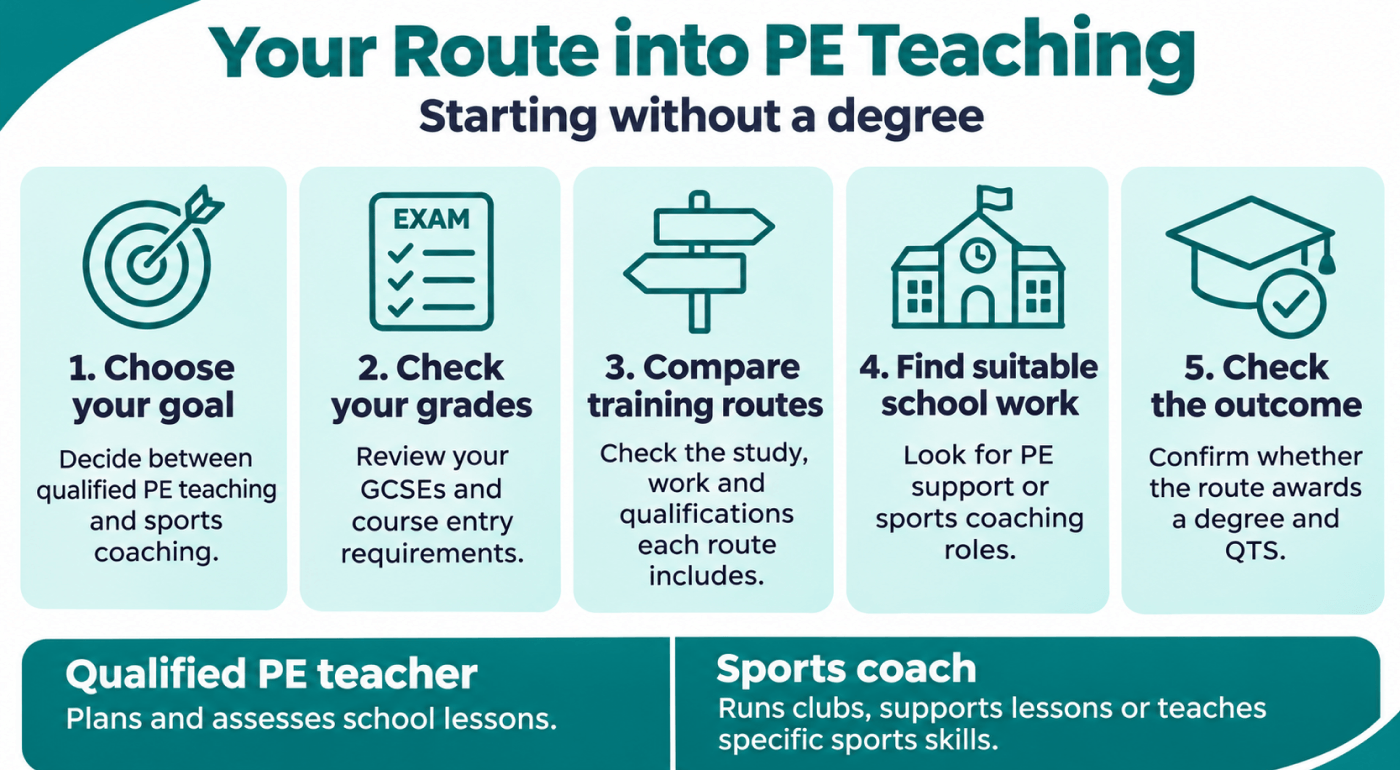
The best route depends on the job you want. A qualified PE teacher plans and assesses school lessons. A sports coach might run clubs, support lessons or teach specific skills. Basically, decide which job you want before choosing your course.
- Choose your goal: Decide whether you want QTS or a school sport role without it.
- Check your grades: Look at GCSE English, maths and any A levels or sports qualifications.
- Compare training routes: Explore paid degree apprenticeships, undergraduate courses and school sports training.
- Find suitable school work: Ask about coaching roles, teaching assistant posts or employer-backed apprenticeships.
- Check the outcome: Confirm what qualification you earn and which jobs accept it.
For example, a school leaver could work towards QTS through a degree apprenticeship. A sports coach with relevant qualifications could seek a school sports role sooner. Yet coaching experience alone will not turn someone into a qualified teacher. If your goal changes later, you can review your qualifications and choose further training.
What Qualifications Do You Need to Become a PE Teacher in England?
Teacher training in England has clear academic entry rules. For undergraduate routes, you need the grades that your chosen course accepts. For postgraduate training, you must already hold a bachelor’s degree or an accepted equivalent. QTS is the professional status needed for most teaching jobs in maintained schools. A postgraduate certificate in education (PGCE) is different: it does not always grant QTS.
- GCSE English and maths: Usually grade 4 or above, or an accepted equivalent.
- GCSE science: Also needed when training to teach primary pupils.
- A levels or similar study: Undergraduate courses and apprenticeships set their own entry grades.
- A bachelor’s degree: Needed before postgraduate training, but not before an undergraduate route.
- QTS: Normally needed for qualified teaching in maintained primary, secondary and special schools.
But what if your GCSE grades are missing? Some training providers accept suitable tests or other proof of your skills. They decide which evidence meets their entry rules. Similarly, an overseas qualification might need a comparison with UK standards. Check this before applying, not after paying a deposit.
Can You Become a PE Teacher Through a Teacher Degree Apprenticeship?
Yes, a teacher degree apprenticeship lets you become a qualified PE teacher without already having a degree. You earn a salary while working in a school and studying towards a bachelor’s degree and Qualified Teacher Status (QTS). Normally, apprentices spend around 40% of their training time on degree study. However, study schedules vary between providers. You also avoid paying tuition fees.
To apply, you must be at least 16 and meet the residency requirements. Generally, applicants need three years of UK residency, although exceptions exist. You also need GCSE English and maths at grade 4 or above. Primary teaching requires GCSE science. Universities set their own A-level or equivalent entry requirements, so check these before applying.
For example, a government-listed PE teacher apprenticeship starts in April 2027 and takes three years. It prepares you to teach pupils aged 11 to 16 and awards a degree with QTS. Applicants need a relevant Level 3 sports qualification and a school willing to employ them. The training also involves experience in another school.
But here’s what matters: finding an apprenticeship course does not guarantee a paid position. Some providers require you to secure a school employer before applying. In maintained schools, apprentices receive pay on the unqualified teacher scale. Other schools can set different salaries. So, check the employer’s support, available funding and entry requirements before choosing this route.
Can You Become a Qualified PE Teacher Through an Undergraduate Course?
Yes, you can become a qualified PE teacher through an undergraduate course without already having a degree. This route combines university study with practical teacher training and leads to a bachelor’s degree and Qualified Teacher Status (QTS). Courses usually take three to four years. You can earn a BA, BSc or BEd, depending on your chosen programme.
However, not every sports-related degree leads to QTS. Primary teacher training covers several subjects, while secondary PE courses focus more on physical education. You also gain practical teaching experience through school placements. So, check whether your chosen course awards QTS before applying.
University courses normally charge tuition fees. In England, the standard full-time fee cap reaches £9,790 for eligible providers in the 2026/27 academic year. However, eligible students can apply for tuition fee and maintenance loans. Check the course fees, funding options and entry requirements before making your decision.
Can Academies or Independent Schools Employ PE Teachers Without QTS?
Some English schools can employ staff who do not hold QTS. However, their legal position depends on the type of school and the role. Maintained schools normally require QTS for teachers carrying out specified teaching work. Academies have historically had more freedom over teacher qualifications. Independent schools have their own staffing arrangements, although they still need suitable and safe staff.
This position is changing for state-funded schools. From 1 September 2027, new teachers in specified state primary and secondary schools must generally hold QTS or be working towards it. The Children’s Wellbeing and Schools Act 2026 supports this change. So, do not plan a long career around an old academy exemption.
But does this mean sports coaches must leave schools? No. Schools can still use suitable staff to support sport and physical activity. The important difference is the work they perform and the supervision they receive. An external coach running an after-school club is not automatically the class teacher. Ask who holds responsibility for lesson planning, pupil progress and safe delivery before accepting a job.
Which Level 3 Sports Qualifications and School Roles Can You Choose Without a Degree?
A recognised Level 3 sports qualification can help you work in school sport. One qualification to consider is the 1st4sport Level 3 Diploma in Delivering Physical Activity and Sport within the School Environment. It covers safe and inclusive sports sessions, both during and outside school hours. The minimum learner age is 17, and its total qualification time is 580 hours.
- School sports coach: Teach suitable sports skills and help pupils enjoy regular activity.
- PE teaching assistant: Support the teacher with activities, equipment and pupil participation.
- School sports instructor: Help deliver planned physical activities within the agreed job role.
- Activity club leader: Run appropriate clubs and sessions beyond normal PE lessons.
These jobs can offer valuable experience, but they have limits. A Level 3 award does not give you QTS. For example, leading a football club is different from assessing a full secondary PE class. Before applying, read the actual job duties rather than trusting a broad job title.
Can a Teaching Assistant Progress to Qualified PE Teaching?
Yes, a teaching assistant can work towards qualified PE teaching. School experience can help with behaviour, routines and pupil needs. However, it does not replace the academic entry rules for teacher training. A supported degree apprenticeship could suit someone already employed in a school. Ask your employer whether it sponsors apprentices and how teaching duties would change during training.
Experienced unqualified teachers sometimes ask about assessment-only QTS. This route still requires a degree and strong proof of independent teaching. Current rules require at least two years’ teaching across two schools, or five years in one school. Ordinary teaching assistant work rarely meets those standards.
Can QTLS Help You Teach PE Without a University Degree?
Qualified Teacher Learning and Skills status, or QTLS, belongs mainly to further education teaching. It recognises eligible teachers working with older learners in FE and skills settings. It is not simply another sports coaching certificate. However, the requirements are far greater than finishing a short online course.
- Teaching qualification: Hold an accepted Level 5 or higher FE teaching award.
- Suitable teaching work: Teach in an eligible setting with learners aged 14 or over.
- Teaching hours: Normally complete 230 hours over six months with groups of five or more.
- Subject and basic skills: Meet the accepted English, maths and relevant Level 3 subject requirements.
- Professional support: Have an eligible supporter and keep the required professional membership.
QTLS holders with the right active membership are recognised as qualified teachers in England. Yet these conditions make QTLS unsuitable as a quick shortcut for most school sports coaches. You need genuine teaching duties, suitable qualifications and professional formation. Practically, it makes more sense to consider QTLS if you already teach sport or another subject in further education. Check current eligibility before changing your career plan.
How Can You Check Whether a PE Course Really Qualifies You to Teach?
Course names can sound almost identical while leading to very different jobs. A completion certificate proves that you finished a course. A regulated sports qualification shows you met that award’s standards. QTS is a separate teaching status. Even a PGCE does not always bring QTS with it. So what should you check before spending your time or money?
- Read the award details: Look for an explicit promise of QTS, a degree or a named sports qualification.
- Check who awards it: Identify the awarding organisation and the training provider.
- Verify official status: Search the regulated qualifications register or government teacher training listings.
- Look at practical work: Check placements, assessed teaching, coaching hours and employer support.
- Match it to a job: Read vacancies and see which qualifications employers actually request.
For example, a course could teach useful PE lesson ideas without awarding QTS. However, it will not meet every schoolteacher job requirement. Equally, a degree apprenticeship offers a clear qualification outcome but needs a suitable employer. Use the government’s regulated qualifications register and teacher training course finder to check the details before enrolling.
How Long Does Each PE Teaching Route Take and How Much Can You Earn?
The time and cost depend on the outcome you want. An undergraduate QTS course normally takes three or four years. A teacher degree apprenticeship also takes several years but combines pay with study. Sports qualifications vary widely, while school support roles may offer immediate work if you meet their requirements.
| Route | Start without degree? | Teaching status gained | Time and funding |
| Undergraduate degree with QTS | Yes | QTS and a degree | Usually 3–4 years; tuition fees |
| Teacher degree apprenticeship | Yes | QTS and a degree | Multi-year; paid, no apprentice tuition fees |
| Level 3 school sports qualification | Often, if eligible | Not QTS | Course-dependent fees and length |
| School coach or support job | Often | Not QTS | Employer requirements vary |
| FE teaching route to QTLS | Sometimes | QTLS if eligible | Depends on experience and qualifications |
Apprenticeship pay can help if you need money while training. However, apprentices work and study at the same time. They are not full-time students on a break from work. University students also need to think about course fees and living costs. A shorter Level 3 course can cost less, but it does not lead to the same teaching jobs. Similarly, a school support role can give you useful experience but it does not promise a place on QTS training.
How Much Can You Earn Without QTS?
From September 2026, unqualified teachers in England earn between £23,732 and £36,494 outside London. Qualified teachers start at £34,069 outside London. These pay rates apply to schools run by local councils. However, pay rates differ across London. Academies and private schools can also set their own pay. Sports coaches and teaching assistants have different work contracts. So, their pay may not match teacher salaries.
For example, an hourly coach might work only during term time. An apprenticeship salary depends on its school employer and pay rules. Before accepting a role, ask about annual hours, paid holidays and training time. A higher hourly rate does not always mean a higher yearly income.
Which PE Teaching Route Is Best for Your Current Qualifications?
Suppose you have just finished college with a sports qualification. An undergraduate teaching course could suit you if QTS is your goal. A teacher degree apprenticeship could also work if you find a sponsoring school. If you want to start earning sooner, a school sports job might fit better.
Now, imagine you already work as a teaching assistant. You know how your school works and how pupils behave. However, you still need the right grades and a training provider that accepts you. If you work as a sports coach, your options may differ. You can continue coaching, gain more school experience or train towards QTS.
There is one simple test for every option. Ask what you can legally and practically do when the course ends. Then look at two or three real vacancies for your target role. If they ask for QTS and your course only gives a sports certificate, you have found a mismatch. Fix that before you enrol, not after you finish.
Final Thoughts: How Should You Start Becoming a PE Teacher Without a Degree?
Learning how to become a PE teacher without a degree begins with choosing the right career path. If you want to gain QTS, consider undergraduate teacher training or a paid degree apprenticeship. However, sports coaching and school support roles offer ways to start without a degree. Each route has different requirements and career opportunities. So, check the qualifications, training costs and job options before choosing your path.
FAQs About How to Become a PE Teacher Without a Degree
1. What Is the Fastest Way to Become a PE Teacher?
Postgraduate teacher training is the fastest route for graduates. It usually takes around nine months to gain QTS in England.
2. What Qualifications Do You Need for a PE Teacher?
You normally need GCSE English and maths at grade 4 or above. Qualified PE teachers in England generally need a degree and QTS.
3. How Quickly Can I Become a PE Teacher?
Graduates can qualify in around nine months. Without a degree, teacher training usually takes three to four years.
4. Are PE Teachers in Demand?
PE teaching jobs are available across the UK. However, demand varies by location and competition can be strong.
5. Are PE Teachers Well Paid?
Yes. Qualified PE teachers in England earn £34,069 to £52,835 on the main pay scale outside London from September 2026.
6. Can I Be a PE Teacher Without Going to University?
Yes, you can work in school sports coaching without a degree. However, qualified PE teaching in England normally requires a degree and QTS.