
The UK property market is exciting and moves very fast. For many people, it is a dream career. It offers a chance to meet new people every day. Also, the money you earn can be very high. You are not stuck at a desk all day. Instead, you are out in your local town. This makes every day feel different and fresh. Therefore, many people want to know how to be an estate agent. It is a job that rewards hard work. If you are friendly and driven, you can succeed.
However, there are some myths about this job. Some think it is just opening doors for people. That is not true. The reality is quite different. It is a sales job. You must be good at negotiation. You also need to be organised. This career suits school leavers looking for a start. It is also great for graduates. Even people changing careers later in life fit in well. This guide covers everything you need to know. We will look at qualifications first. Then, we will discuss interviews. Continue reading to find out how to be a successful estate agent.
How to Be an Estate Agent in the UK: Where Do You Start?
You might be wondering where to begin. Do you need a university degree? The answer is generally no. You do not need formal qualifications to get started. This is good news for many new arrivals in the UK. You can start this career straight from school. However, you need the right attitude. Employers look for potential more than papers.
But school grades can help you. Helpful GCSEs include Maths and English. Good grades here show you are capable. For example, you need Maths to work out commission. You need English to write property descriptions. Therefore, having a C grade or level 4 is good. A-levels can also be useful. They show you can study and learn. However, they are not strictly necessary.
So, can you become an estate agent without a degree? Yes, absolutely. Most agents learn on the job. Experience is often valued more than a degree. But there is another route. Are apprenticeships a good route into property? Yes, they are excellent. An apprenticeship lets you learn while you work. You also earn money while you learn. This is a great way to enter the industry.
There is one very important rule, however. Do you need a driving licence to work in an estate agency? In most cases, yes. You must visit many houses in one day. Public transport is usually too slow. Therefore, a full UK driving licence is crucial. If you do not drive, it is hard to get hired.
Do You Need Specific Qualifications to Become an Estate Agent?
Let us look at the legal rules. In the UK, the law is currently relaxed. You do not legally need a degree to sell houses. This is different from the USA or other countries. In the UK, anyone can technically set up an agency. However, getting hired is competitive. Therefore, showing some skill is helpful.
As mentioned, Maths and English are key. You will deal with contracts. You will also calculate prices. Employers want to see that you are competent. If you have these GCSEs, put them on your CV. They prove you have basic office skills.
There are also voluntary qualifications. You can study for these yourself. For example, look at NAEA Propertymark qualifications. Or, for renting homes, look at ARLA Propertymark. These are industry bodies. Having these certificates makes you stand out. It shows you are serious about how to be an estate representative.
Finally, consider the apprenticeship route again. A Junior Estate Agent apprenticeship is very popular. You work for a real company. They pay you a wage. At the same time, you study for a qualification. This usually takes about 12 to 18 months. It is a safe and smart way to start.
Top Tips on How to Be an Estate Agent Without Experience
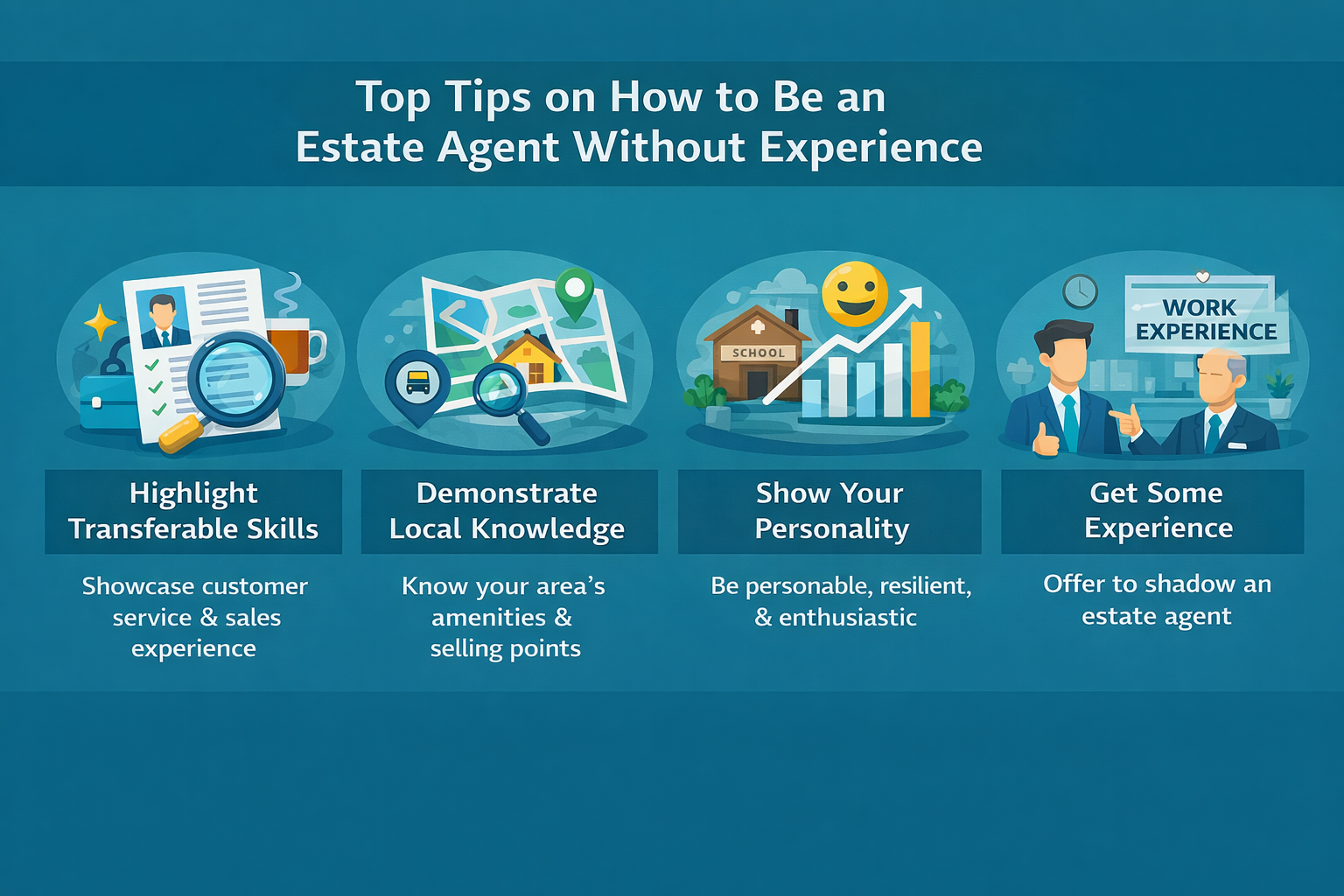
Many people ask how to be an estate agent with no experience. It might seem hard at first. However, you likely have transferable skills. Have you worked in a café or shop? That is customer service. Have you worked in a call centre? That is sales. These jobs teach you how to talk to people. Estate agents need these exact skills. Therefore, highlight this experience on your CV.
Another tip is to demonstrate local knowledge. Agents need to know their area well. Do you know where the best schools are? Furthermore, do you know the bus routes and the local parks? Employers love this knowledge. It helps you sell the lifestyle, not just the house. This can impress a manager more than a degree.
Also, you must show personality and resilience. Agencies hire for attitude. They train for skill. They want someone happy and energetic. But you also need to be tough. Sometimes sales fall through. You must be able to bounce back.
Finally, offer to shadow someone. Ask a local agency for work experience. Even one week is helpful. It shows you are keen. It helps you get a foot in the door.
High Street vs. Online Agents: Understanding the Models. Which Path Should You Choose?
There are different types of estate agents. The two main ones are High Street and Online. High Street agents have a physical shop. You sit in an office in town. Online agents work remotely or from home. You need to choose the right path for you.
First, there is the Sales Negotiator role. This is the most common job. You help people buy and sell homes. The commission can be high here. However, sales take a long time to finish. It can take months. You also manage the emotions of buyers. It can be stressful but rewarding.
Second, there is the Lettings Negotiator role. This is about renting houses. It is very fast-paced. You deal with landlords and tenants. The turnover of houses is quicker. There is also more paperwork regarding laws. If you like speed, this is for you.
Third, there is Property Management. This is the administrative side. You look after the house after it is rented. Then, you arrange repairs for broken things, and also handle deposits. This is less about sales. It is more about service and organisation.
How Much Can You Earn as a Trainee Estate Agent?
Money is a big question. Learning how to be an estate representative involves understanding pay. In the UK, pay has a specific structure. It is called ‘basic salary plus commission’. This creates your “On-Target Earnings” (OTE).
The trainee’s base salary is usually low. It is often between £18,000 and £22,000 a year. This is your guaranteed money. However, you also earn commission. This is a bonus for selling a house. Commission is usually a percentage. It is typically 5% to 10% of the office fee. It is not a percentage of the total house price. For example, if the agency gets £3,000, you might get £300. This adds up quickly if you sell many homes.
Also, remember that commission is taxed. The government takes a share. So, your take-home pay might vary each month. Typical starting figures vary by location. A Trainee Negotiator in London earns more. Their OTE might be £30,000 or more. In the rest of the UK, it might be £25,000.
Finally, ask about car allowances. Some companies give you a company car. Others pay for your mileage. This helps cover your travel costs.
What Daily Tasks Does an Estate Agent Actually Do?
The day is never boring. It usually starts with morning meetings. The team gathers around 8:30 AM. You review new leads. You discuss what houses are available. This sets the plan for the day. Then, you start prospecting. This means finding new business. You might call people who want to sell. You might drop leaflets in doors. This is called canvassing. It requires confidence. You cannot be shy on the phone.
Conducting viewings is a big part of the day. You drive to a property. Hence, you show potential buyers around. Also, you point out the good features and answer their questions. This is where your personality shines. Negotiation happens when someone makes an offer. Therefore, you act as the middleman. You talk to the buyer and the seller. Also, you try to agree on a price. This is the most exciting part.
Finally, there is sales progression. Once a price is agreed, the work continues. You must chase solicitors. Besides, you talk to surveyors and ensure the sale actually completes.
What Skills Do You Need to Succeed as an Estate Agent?
To master how to be an estate representative, you need specific skills. First, are communication and negotiation skills essential? Yes, they are. As you talk all day long, you must listen well, too. Also, you need to persuade people politely.
How important are confidence and resilience? Very important. You will hear the word “no” often. People can be rude. You must stay happy and professional. You need a “thick skin”.
Do you need strong maths skills? Perhaps you need basic maths. You need to work out the percentage and measure the rooms. However, you do not need to be a mathematician.
Is networking key to long-term success? Yes. You need to know people. Chat with mortgage brokers. Meet local business owners. The more people you know, the more houses you sell.
Is Being an Estate Agent a Stressful Job?
We must be honest here. It’s important to understand the drawbacks of being an estate agent. It can be stressful.
First, look at the working hours. You often work on Saturdays. Most people view houses on weekends. Therefore, you must be available. You might also work late evenings. You have to work when your clients are free.
Next, there is the target pressure. You have monthly goals. Your boss will set a target. For example, “Sell four houses this month.” If you miss the target, it can be stressful. You are constantly chasing the next deal.
Dealing with rejection is also hard. You might work hard on a sale. Then, at the last minute, the buyer pulls out. This happens often. You lose your commission. You have to start again. This is why resilience is the most cited requirement.
Is Being an Estate Agent a Good Career in 2026?
Is this a good job for the future? Yes, the UK property market is stable. People always need homes. They need to move for jobs or schools. Therefore, agents are always needed.
The working hours are long, as mentioned. However, the rewards are good. Hard work leads to high pay.
Is the job stressful? Yes, but it is also fun. The team spirit in an office is usually great. You celebrate wins together.
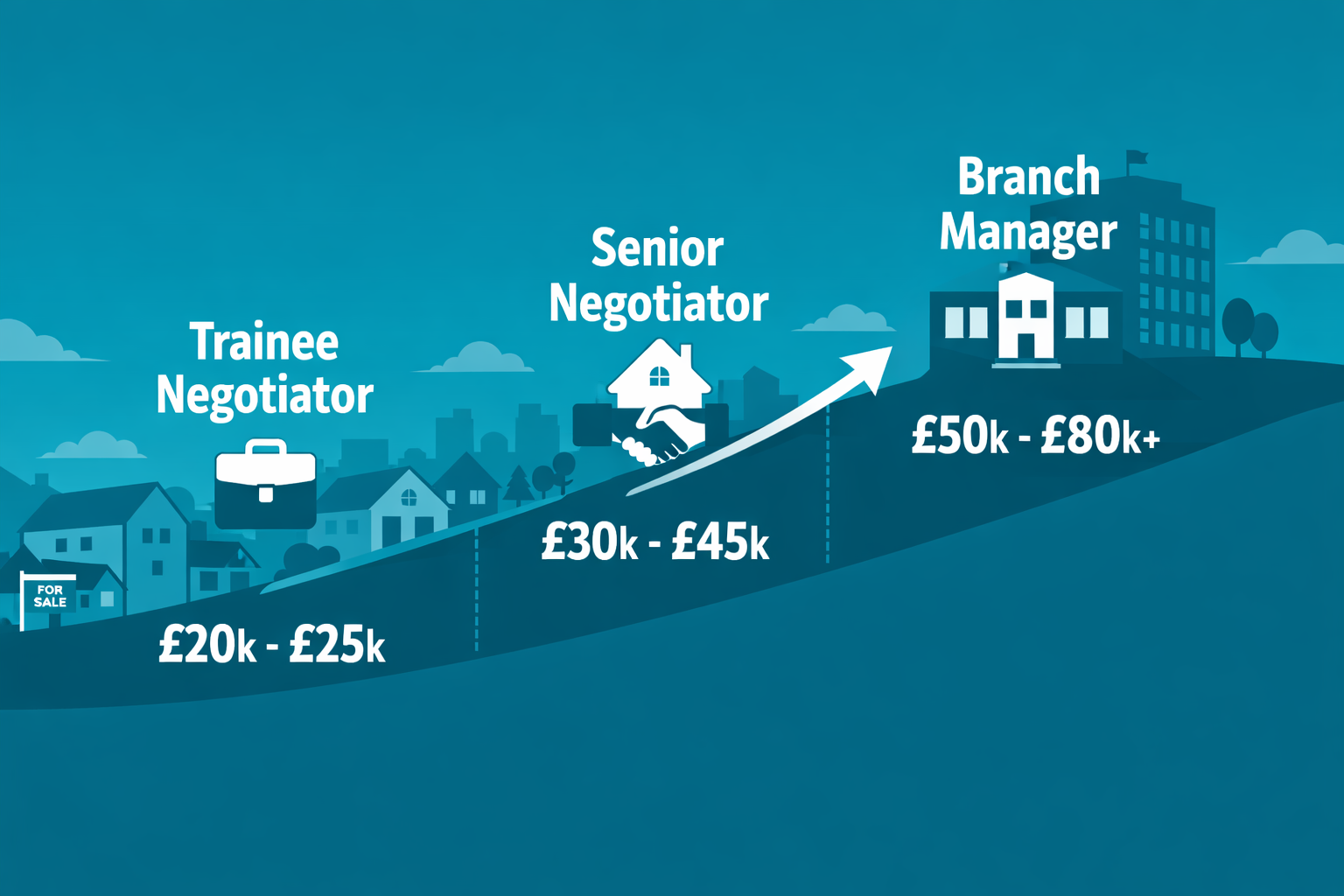
What about long-term career progression options? They are excellent. You start as a Trainee. Then you become a Senior Negotiator. After that, you can be a valuer. Eventually, you can be a Branch Manager. You could even become a Director. The path is clear.
Do You Need Specific Qualifications? (RoPA Update)
We discussed qualifications earlier. Currently, they are voluntary. However, things are changing. The government is looking at the RoPA report. This stands for “Regulation of Property Agents”.
The report recommends mandatory licensing. This means in the future, you must qualify. It suggests a Level 3 CPP qualification. This might become the law soon.
Therefore, getting qualified now is smart. It future-proofs your career. If you start studying now, you will be ready. You will be ahead of other people. Employers will see this as a huge positive. It shows you take the career seriously. Explicitly mention RoPA in your interview to impress them.
How to Land Your First Estate Agent Job: CV & Interview Tips
You need a job now that you understand how to become a real estate professional. Your CV is the first step. You must include specific keywords. Use words like “customer service”. Add “target-driven” to show you like goals. Definitely add “clean driving licence”. These words help you pass the initial check.
Prepare for common interview questions. They might ask, “Sell me this pen.” This tests your sales skills. They might say, “Describe a time you handled a difficult customer.” Have a story ready. Explain how you solved a problem.
Finally, think about dress code expectations. Estate agency is a corporate world. Men should wear a suit and tie. Women should wear smart business clothes. You need to look professional. You are representing someone’s most expensive asset. Therefore, appearance matters a lot.
Final Thoughts
In summary, learning how to be an estate agent is a great journey. The entry barrier is low. You do not need a degree. However, success requires hard work. You need resilience and energy. Recap quickly how to enter the industry. Get your driving licence. Polish your CV with customer service skills. Apply for trainee roles or apprenticeships. Be ready to learn.
If you are ready, apply today. The UK housing market is waiting for you. It offers a clear property sales career path. Good luck with your new adventure!
Frequently Asked Questions (FAQs)
1. Do estate agents earn a lot of money?
- Estate agents can earn good money through salary and commission, but income depends on location, sales skills, and market conditions.
2. Is it hard to own an estate agent?
- Owning an estate agency can be challenging because it requires business skills, legal knowledge, marketing, and strong sales ability.
3. What GCSEs for an estate agent?
- There are no fixed GCSE requirements, but English and Maths are helpful for communication and handling property finances.
4. Is it hard to get into real estate in the UK?
- It is not very hard to start in UK real estate, but success takes training, confidence, and strong people skills.
5. Who earns 250k a year in the UK?
- High earners in the UK often include senior executives, successful business owners, top lawyers, specialist doctors, and experienced finance professionals.
6. Is being an estate agent worth it?
- Being an estate agent can be worth it if you enjoy sales, working with people, and earning through commission.
7. What jobs earn 300k a year in the UK?
- Jobs that may earn £300k a year include investment bankers, surgeons, hedge fund managers, top barristers, and large company CEOs.